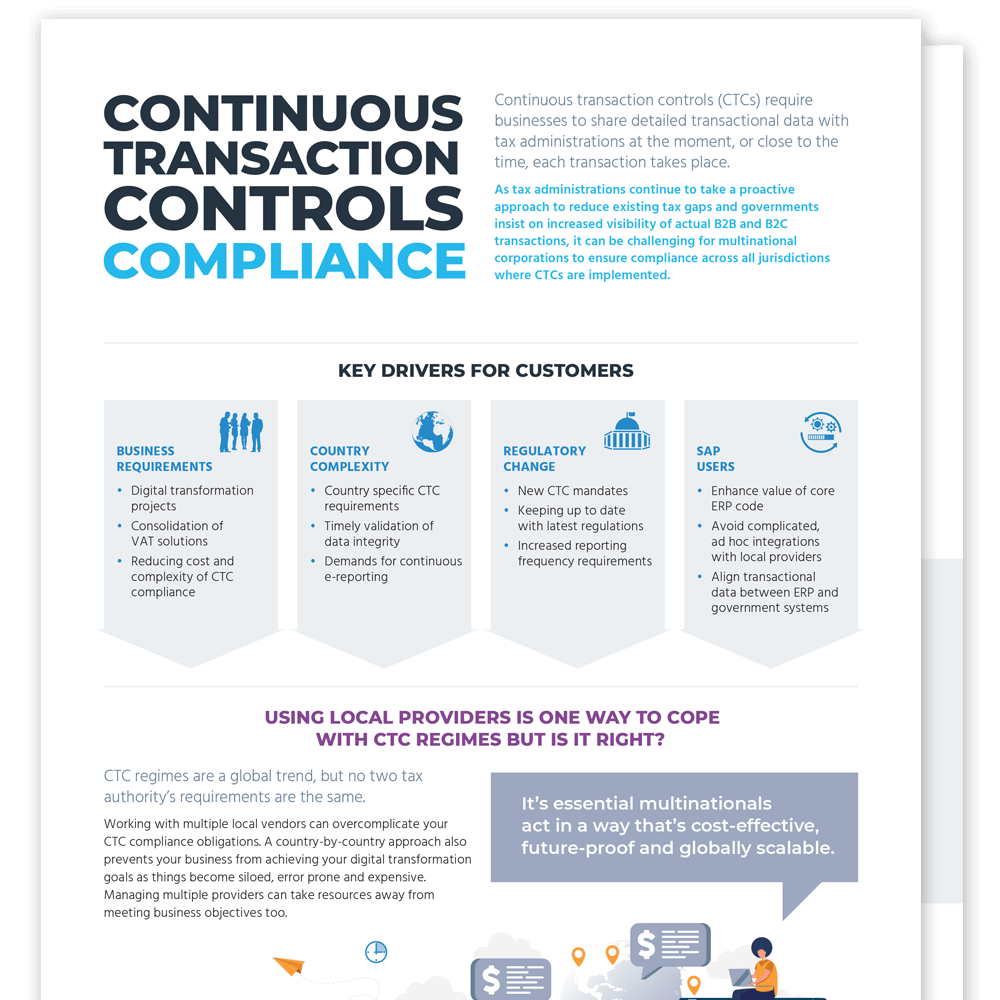
A current mega-trend in VAT is continuous transaction controls (CTCs), whereby tax administrations increasingly request business transaction data in real-time, often pre-authorising data before a business can progress to the next step in the sales or purchase workflow.
When a tax authority introduces CTCs, companies tend to view this as an additional set of requirements to be implemented inside ERP or transaction automation software by IT experts. This kneejerk reaction is understandable as implementation timelines tend to be short and potential sanctions for non-compliance significant.
But businesses would do better to approach these changes as part of an ongoing journey to avoid inefficiencies and other risks. From a tax authority perspective, CTCs are not a standalone exercise but part of a wider digital transformation strategy where all data that can be legally accessed for audit purposes is transmitted to them electronically.
It’s all about the data
In many tax authorities’ vision of digitization, each category of data is received at ‘organic’ intervals that follow the natural cadence of data processing by the businesses and data needs of governments.
Tax administrations use digitization to access data more conveniently, on a more granular level, and more frequently.
A business that doesn’t consider this continuum from the old world of reporting and audit to the new world of automated data exchange risks over-focusing on the ‘how’ – the orchestration of messages to and from a CTC platform – rather than keeping a close eye on the ‘why’ – transparency of business operations.
Data received quicker and in a structured, machine-exploitable format is infinitely more valuable for tax administrations as it gives them an opportunity to perform deeper analysis of both varying taxpayer and third-party sources of data.
If your business data is incomplete or faulty, you are likely exposing yourself to increased audits, as your bad data is under scrutiny and more transparent to the taxman.
Put differently, in a digitized world of tax, garbage-in will translate to garbage-out.
How to prepare for CTCS – automation is key
Many companies already have the magic formula to fix these data issues at their fingertips. Start by preparing for this wave of VAT digitization with a project to analyse internal data issues and work with upstream internal and external stakeholders – including suppliers – to fix them.
Tools designed to introduce automated controls for VAT filing processes can help achieve better insight into the upstream data issues that need ironing out. These same tools can also help you through the CTC journey by re-using data extraction and integration methods set up for VAT reporting for CTC transmission, thereby creating better data governance and keeping a connection between these two naturally linked processes.
A lot of bad data stems from residual paper-based processes such as paper or PDF supplier invoices or customer purchase orders. Taking measures now to switch to automated processes based on structured, fully machine-readable alternatives will make a big difference.
Improving invoice data is not the only challenge. With the inevitable broadening of document types to be submitted under CTC rules (from invoice to buy-side approval messages, to transport documents and payment status data) tax administrations will cross-check more and more of your data, as well as trading partners’ and third parties’ data — think financial institutions, customs, and other available data points.
Tax administrations are unlikely to stop their digitization efforts at indirect tax. Mandates to introduce The Standard Audit File for Tax (SAF-T ) and similar e-accounting requirements show how quickly countries are moving away from the old world of tax and onsite audits.
All this data, from multiple sources with strong authentication, will paint an increasingly detailed and undeniable picture of your business operations. It is just a matter of time before corporate income tax returns will be pre-filled by tax administrations who expect little to no legitimate changes from your side.
‘Substance over form’ is a popular aphorism in the world of tax. As more business applications and data streams become readily accessible by tax administrations, you need to start considering data quality and consistency as a first step towards thriving in the world of digitized tax enforcement.
Aim for more, not less, insight into your business than the taxman
In the end, tax administrations want to understand your business. They don’t just want data, they want meaningful information on what you do, why you do it, how you trade, with whom and when. This is also exactly what your owners and management want.
So the ultimate goals are the same between businesses and tax administrations – it’s just that businesses will often prioritise operational efficiency and financial objectives whereas tax administrations focus on getting the best, most objective information possible.
Tax administrations introducing CTCs as an objective may be a blessing in disguise, and there are benefits of introducing better analytics to your business to comply with tax administration requirements.
The real value lies in real-time insight into business operations and financial indicators such as cash management or supply chain weaknesses. This level of instant insight into your own business also enables you to always be one step ahead, leaving you in control of the picture your data is providing to governments.
CTCs are the natural next step on a journey to a brave new world of business transparency.
Turkey’s e-transformation journey, which started in 2010, became more systematic in 2012. This process first launched with the introduction of e-ledgers on 1 Jan 2012 and has since reached a much wider scope for e-documents.
The Turkish Revenue Administration (TRA), the leader of the e-transformation process, has played an important role in encouraging companies to embrace the digitalization of tax and created a successful model for following tax-related procedures.
The process was further accelerated with new requirements for e-documents.
Latest developments and expectations in Turkey’s e-transformation
The TRA continues to widen the scope of e-documents and the types of e-documents in use are:
Expense E-Note: This application helps you create electronic expense notes in accordance with TRA standards, retain electronic and hard copies of these notes, submit them to relevant parties and prepare reports.</
E-Bank Receipt: With this application, you can create electronic bank receipts in accordance with TRA standards, keep copies of receipts or submit these copies to relevant parties and prepare reports.
E-Foreign Exchange Receipt: This allows you to convert forex trading documents into electronic documents via relevant institutions and banks.</
E-Insurance Commission Expense Letter: This is an expense note which is created by insurance brokers in an electronic format according to the legislation.
E-Insurance Policy: This document is the electronic version of insurance policies issued by insurance, pension and reinsurance brokers.
E-Tab: This document shows the list of orders placed by customers in restaurants and cafés.
The digitization journey of e-documents
Many taxpayers have voluntarily adopted the new system since the TRA launched this whole process and TRA’s latest updates for e-documents are critically important to monitor for tax-related procedures.
As e-documents become more popular, any income loss arising from tax procedures will reduce. E-documents offer additional advantages for public institutions and private businesses, such as saving time, minimising costs and improving productivity. It’s certain that the scope of e-documents in Turkey will keep expanding in the future, which will affect taxpayers and tax procedures.
Take Action
Get in touch to find out how Sovos tax compliance software can help you meet your e-transformation and e-document requirements in Turkey.
Since 1993, supplies performed between Italy and San Marino have been accompanied by a set of customs obligations. These include the submission of paperwork to both countries’ tax authorities.
Italy and the enclaved country of San Marino will abandon paper-based customs flows.
The Italian and Sammarinese tax authorities have decided to implement a “four-corner” model, whereby the Italian clearance platform SDI will become the access point for Italian taxpayers, while a newly created HUB-SM will be the SDI counterpart for Sammarinese taxpayers.
Cross-border e-invoices between the countries will be exchanged between SDI and HUB-SM. The international exchange system will be enforced on 1 July 2022, and a transition period will be in place between 1 October 2021 and 30 June 2022.
FatturaPA: The format of choice
HUB-SM’s technical specifications are now available for imports from Italy to San Marino, and exports from San Marino to Italy. The countries have also decided to choose FatturaPA as the e-invoice format, although content requirements for export invoices from San Marino will slightly differ from domestic Italian FatturaPA e-invoices.
The SDI and HUB-SM systems will process e-invoices to and from taxpayers connected to them, or under each country’s jurisdictions.
In other words, Italian taxpayers will send and receive cross-border invoices to or from San Marino via the SDI platform, while Sammarinese taxpayers will perform the same activities via HUB-SM.
Both platforms will deliver invoices to the corresponding taxpayers through the Destination Codes assigned by the respective tax authorities. This means HUB-SM will also assign Destination Codes for Sammarinese companies.
Integration documents for Sammarinese companies
Inspired by the Italian methodology for fiscal controls in cross-border transactions, San Marino will require Sammarinese buyers to fill out an additional integration document (similar to a “self-billing” invoice created for tax evidence reasons) upon receipt of the FatturaPA. This document will be filled out in a new XML-RSM format created by the enclave and sent to HUB-SM.
After the larger rollout of the SDI for B2B transactions in 2019, the platform has proven capable of adapting to new workflows and functionalities.
SDI has already debuted in the international arena through the acceptance of the e-invoices following the European Norm, which are mapped into a FatturaPA before being delivered to Italian buyers. This integration between SDI and HUB-SM might also reveal the early steps of interoperability between both tax authorities’ platforms for cross-border trade.
Take Action
Get in touch with our experts who can help you understand how SDI and HUB-SM will work together.
VAT in Norway: All you need to know about Norway’s SAF-T Requirements
Norway’s SAF-T reporting requirements are evolving as tax continues to digitize
Reform Designed to reduce the compliance burden and administrative costs associated with audits, while giving tax authorities greater visibility of company’s tax and financial data, SAF-T has continued to gain popularity across a growing number of European countries.
Initially introduced in 2017 on a voluntary basis, Norway’s tax authority made SAF-T reporting compulsory in January 2020.
At present, the Norwegian SAF-T must only be submitted on demand in connection with an audit. However, it is expected to be extended to areas such as corporation tax.
On 1 January 2022, the tax authority introduced digital submission of its VAT return, which was also enhanced to capture other data that’s already required whenever a SAF-T submission is needed. However, as SAF-T doesn’t yet need to be submitted regularly in Norway, the completion of these new summary boxes creates a challenge for companies who are unfamiliar with SAF-T.
Have questions? Get in touch with a Sovos expert on Norway SAF-T.
Norway SAF-T Quick facts
Norway’s SAF-T requirements apply to businesses with bookkeeping obligations who use electronic accounting systems including registered foreign bodies.
Businesses with a turnover of less than NOK 5 million who aren’t subjected to mandatory bookkeeping are exempt unless they have electronic bookkeeping information available.
Enterprises with less than 600 vouchers annually that hold accounts in spreadsheets or a text editor program are exempt.
Norwegian SAF-T is submitted on request and doesn’t currently have periodic submission requirements.
SAF-T is a standardised XML format containing exported accounting information.
Norwegian SAF-T files will be submitted primarily by upload via the Altinn internet portal.
Testing is available and recommended by the tax authority.
Mandate rollout dates
1 October 2016: The first version of the SAF-T Financial was published on the Norwegian tax authority website.
9 June 2017: The administrative body on Norwegian SAF-T standards met for the first time to manage standards to suit both public and private sectors. The body meets at least once a year.
1 January 2017: Voluntary adoption of SAF-T began.
1 January 2020: Norway introduced mandatory SAF-T reporting on demand.
1 January 2022: Norway updated its VAT Return to allow for more detailed reporting and flexibility, as the new return structure removes numbered boxes and instead requires users to map their transactions to Norway’s existing tax codes that are currently utilised in the SAF-T mandate. The submission frequency of the VAT return remains the same, but users can now directly submit returns from their ERP system to allow for a more efficient process; where this is not possible, users may still upload XMLs or manually populate data via a portal.
INFOGRAPHIC
Norway’s SAF-T Requirements
Understand more about Norway SAF-T including when to comply, submission deadlines and filing requirements and how Sovos can help.
It’s a challenge to extract data from the ERP, map to the correct SAF-T format and ensure it meets tax authority requirements without triggering the need for further scrutiny. Sovos software takes care of this by extracting the data, performing a full analysis and generating the submission-ready SAF-T file.
Our experts continually monitor, interpret and codify regulatory changes into our software, reducing the compliance burden on your tax and IT teams.
Learn how Sovos’ solution to address the changing VAT compliance requirements in Serbia can help companies stay compliant.
Making Tax Digital is part of the UK government’s plans to reduce errors and make managing tax affairs easier using digital tools.
Businesses must digitally file VAT returns using one of the HMRC-recognized compatible software solutions that connect to HMRC’s API. Using software to keep digital records of specified VAT-related content is compulsory.
Understanding MTD
The UK government introduced Making Tax Digital (MTD) with the aim of making filing VAT returns easier and more efficient for businesses
The regulation requires businesses to keep digital records and submit VAT returns via compatible software.
Making Tax Digital applies to all VAT-registered businesses in the UK. Electronic submission of VAT returns, digital record keeping and digital links are all requirements of the regulation.
MTD doesn’t currently apply for corporation tax, but HMRC published the results of its consultation – and there are plans for a pilot scheme. A potential mandate is likely in 2026. Bookmark this page to stay on top of future updates to the regulation.
The UK government introduced Making Tax Digital (MTD) with the aim of making filing VAT returns easier and more efficient for businesses
The regulation requires businesses to keep digital records and submit VAT returns via compatible software.
Making Tax Digital applies to all VAT-registered businesses in the UK. Electronic submission of VAT returns, digital record keeping and digital links are all requirements of the regulation.
MTD doesn’t currently apply for corporation tax, but HMRC published the results of its consultation – and there are plans for a pilot scheme. A potential mandate is likely in 2026. Bookmark this page to stay on top of future updates to the regulation.
Making Tax Digital (MTD): Quick facts
MTD requires every VAT registered business to record and submit VAT returns electronically using ‘functional compatible software’.
Companies must use software to keep digital records of specified VAT-related documents.
Stored records must include designatory data and summary VAT data for the period.
Use of multiple pieces of software is allowed.
The format of the VAT return is a 9-box summary, filed via the HMRC’s JSON API platform, which must be digitally linked between the customer’s source data and the submitted digital return. Businesses receive and send information to HMRC via API.
Each business must set up a new digital tax account and should follow a new authentication process.
Submission of digital records can be in a range of digital formats, including XML, CSV, and Excel, provided they are API enabled.
Making Tax Digital (MTD): Roll out dates
1 April 2019: MTD for VAT introduced to UK VAT registered businesses exceeding annual gross sales of £85,000.
1 October 2019: MTD applies for businesses eligible for deferral.
1 April 2021: The ‘soft landing’ for digital links ended. Starting with that tax period, all MTD users must meet digital link requirements. HMRC may consider deferrals for taxpayers with complex legacy systems.
1 April 2022: Mandate expanded to include all businesses registered for UK VAT, regardless of size.
1 November 2022: Businesses filing VAT returns can no longer submit via an existing online VAT account unless HMRC has agreed to an exemption from MTD. Businesses that file annual VAT returns will still be able to use their VAT online account until 15 May 2023.
January 2023: Any VAT registered businesses that fail to sign up for MTD and file returns through MTD-compatible software will incur a default surcharge or late submission penalty and interest.
6 April 2026: Self-employed persons or landlords must follow MTD requirements if they have an annual basis or property income surpassing £50,000
April 2027: Self-employed persons or landlords must meet MTD requirements when their income surpasses £30,000
Penalties for not complying with Making Tax Digital
Not complying with the HMRC’s requirements for MTD may lead to penalties. These can include:
A default surcharge of up to 15% for any late payments of VAT due.
Up to 100% of any VAT understated or over-claimed if a VAT return contains a careless or deliberate inaccuracy.
Up to 30% of an understated assessment of VAT due if HMRC isn’t informed within 30 days that it’s incorrect.
£400 for submitting a paper VAT return without an exemption.
MTD digital links
One of the MTD requirements is ‘digital links’ – the electronic exchange of data between software programs, products or applications without manual intervention.
A digital link is required whenever a business uses multiple pieces of software to store and transmit its VAT records and returns in accordance with MTD requirements.
A digital link can be
XML, CSV import and export, and download and upload of files
Automated data transfer
API transfer
Transfer of data and subsequent import of data into software by means of email or tangible digital media (i.e. flash drive)
Making Tax Digital for Corporation Tax
MTD doesn’t currently apply for corporation tax but HMRC published results of its consultation and there are plans for a pilot scheme. A potential mandate is likely in 2026. Bookmark this live blog about updates for MTD or follow us on LinkedIn to stay up to date.
How to set up Making Tax Digital with Sovos
Sovos can help you with MTD in two ways:
You can use Sovos VAT Filing software to streamline your compliance workload with one solution, or
You can use Sovos’ Compliance Services Portal to access expert VAT compliance services and get full visibility of how each obligation is being handled, every step of the way.
FAQ
Can I use Excel for Making Tax Digital?
You can submit digital records using Excel as part of Making Tax Digital, as long as the file is API-enabled, or the spreadsheet is digital. However, using Excel can prove inefficient and error prone in comparison to other digital record software options.
How do I setup MTD?
There are a few steps involved in setting up Making Tax Digital for your business:
Check the permissions in the software– filing VAT returns is easy once a business has allowed it to work with Making Tax Digital.
Keep digital records for current and future VAT returns– a business can find out what records need keeping here.
Sign up for Making Tax Digital and file future VAT returns using MTD-compatible software – Sovos’ VAT Filing solution streamlines periodic reporting obligations including MTD and other global VAT reporting requirements.
Who needs to register for Making Tax Digital?
All UK VAT-registered businesses need to register for Making Tax Digital. New businesses will be automatically signed up for MTD when registering for VAT through HMRC’s new VAT Registration Service (VRS).
What is the threshold for Making Tax Digital?
Since April 2022 Making Tax Digital is mandatory for all VAT registered businesses, regardless of annual turnover.
Do sole traders have to make tax digital?
If a sole trader is a VAT registered business, they will have to comply with the Making Tax Digital requirements. In the UK, businesses with an annual turnover of less than £85,000 can opt to register their business for VAT but it is not compulsory.
In an effort to modernise its tax systems and close the VAT gap, Poland’s tax authority, the Krajowa Administracja Skarbowa (KAS), continues to advance its implementation of VAT reform with changes to SAF-T and the introduction of continuous transaction controls (CTCs).
Get the information you need
Poland’s SAF-T evolution
Poland introduced its version of the Standard Audit File for Tax (SAF-T) known as Jednolity Plik Kontrolny (JPK) in 2016. This incorporated multiple regulated JPK structures, of which two, JPK_VAT and JPK_FA, were relevant for VAT.
The requirement for monthly submissions of JPK_VAT was extended to all taxpayers on 1 January 2018. JPK_VAT was combined with the VAT return during 2020 and the consolidated JPK_VAT with the declaration is submitted per the frequency of the VAT Return (monthly or quarterly).
JPK_VAT with the declaration has two variants:
JPK_V7M for taxpayers settling VAT monthly
JPK_V7K for taxpayers who settle VAT quarterly
The remaining JPK structures are submitted upon request of the tax authority in event of an audit.
SAF-T quick facts
There are eight Polish JPK structures that taxpayers should be prepared for. Most are required on demand, but the JPK_V7M/K must be submitted periodically (monthly or quarterly).
JPK_V7M/K declaration for records of VAT purchases and sales combined
JPK_FA for VAT and VAT invoices
JPK_WB for bank statements
JPK_PKPIR for revenue and expense ledger
JPK_EWP for revenue account
JPK_KR for accounting books
JPK_MAG for warehouses
JPK_FA_RR for flat rate VAT invoices
Poland’s CTC reforms
Aiming to combat fraud and improve tax collection capabilities, Poland’s first Continuous Transaction Controls (CTC) legislation, the Krajowy System e-Faktur (KSeF), was published in Poland in early 2021.
Adoption of the proposed CTC reform occurred on 18 November 2021, following consultation with industry representatives. The implementation process is ongoing, with the voluntary phase having begun in January 2022 and the mandate due to go-live on 1 July 2024.
CTC quick facts
Participants who wish to get ahead of the mandate can now opt to use the Polish electronic invoice in structured XML format the FA-VAT, to submit supplier invoices to the KSeF (Krajowy System e-Faktur) electronically.
Other considerations for businesses include:
During the voluntary phase, buyer acceptance of e-invoices is necessary to receive invoices via KSeF (otherwise supplier will still need to issue invoices in the agreed form/format, such as PDF, paper or via EDI)
Refund period reduced from 60 to 40 days
Incentives provided to businesses to issue invoices through the KSeF portal during voluntary phase
Outsourcing using third-party service provider will be permitted
All invoices will be archived in KSeF for ten years
A qualified electronic signature or seal (QES), trusted profile or token will be required to authenticate access to the portal
Mandate rollout dates for JPK and CTCs in Poland
Poland SAF-T
1 July 2016: SAF-T introduced in Poland in the form of JPK files
1 January 2018: Poland mandated JPK_VAT for all taxable persons
1 July 2018: Taxpayers must be able to produce accounting documents in JPK structures
1 October 2020: JPK_VAT with declaration consolidates the VAT Return and JPK_V7M/K
1 July 2021: Amendments to the mandatory JPK_V7M/K adopted
1 January 2022: Amendments to the JPK_V7M/K structure including changes to better align it with the EU VAT e-Commerce package
1 January 2025: Reporting of JPK EWP, JPW PKPIR, and JPK_KR becomes a periodic reporting obligation
Poland CTC
29 October 2021: Legislation for a Continuous Transaction Control (CTC) e-invoicing system adopted; draft specifications released and test system made available
1 January 2022: Voluntary phase begins for the CTC system. There is no obligation to use the e-invoicing system in B2B transactions though there are several benefits if businesses chose to do so, including quicker tax refunds and exemptions from submitting the report of invoices, JPK-FA
10 June 2022: The Council of the European Union published the Council Implementing Decision authorizing the Republic of Poland to apply a special measure derogating from Articles 218 and 232 of Directive 2006/112/EC, based on the European Commission proposal published on 30 March 2022. The decision will be granted from 1 January 2024 until 31 December 2026, after being published in the Official Journal of the European Union.
1 July 2024: The CTC system will become mandatory
1 January 2025: The mandatory e-invoicing expands to the VAT-exempted taxpayers
1 January 2025: The end of the grace period for the application of the penalties
Penalties
The new SAF-T structure, like the JPK_VAT and VAT returns, must be submitted monthly, or quarterly. Failure to submit accurately and on time may result in penalties. The Polish tax authority will react quickly to inconsistencies detected in SAF-T files and use data analysis algorithms to identify fraudulent transactions.
INFOGRAPHIC
Poland's SAF-T Requirements
Understand more about Poland SAF-T including when to comply, penalties, requirements and how Sovos can help.
Need help to ensure your business stays compliant with the evolving reporting and emerging SAF-T and CTC obligations in Poland?
Keeping up with VAT compliance obligations has become more difficult as Poland continues to take steps to reduce its VAT gap and modernise the system.
Our experts continually monitor, interpret and codify complex legal and technical changes into our software solutions, keeping you up-to-date and reducing the compliance burden on your tax and IT teams.
Learn how Sovos’ solution for JPK_V7M/K, CTC reforms and other VAT compliance changes can help companies stay compliant in Poland and around the world.
SII Spain is an electronic VAT system that affects thousands of large companies across the country. It can seem complicated, but it doesn’t have to be.
The mandate is demanding, with the impacted groups having to stay on top of the four-day reporting period. If your business meets the criteria of SII Spain, you will likely be feeling the pressure of having to comply.
Sovos is here to help, breaking down Spain’s SII system into:
How companies can comply (and what to expect if they don’t)
Key details about the mandate and how it’s developed over time
How Sovos can ease the burden for you at every stage
SII Spain is only one of the country’s tax compliance obligations. Our Spain VAT Compliance overview can help you stay on top of other mandates and obligations you may be subject to.
The mandate affects Spanish companies above an annual turnover threshold of over €6 million. It’s also applicable to VAT business groups, companies that participate in the monthly tax refund system known as REDEME and other businesses that voluntarily sign up.
Where is SII applicable in Spain?
Spain’s compliance obligations are further complicated by the country being divided into regions. Depending on where your business is based, you may well be subject to a specific combination of tax mandates.
The distinct areas where SII is applicable include:
Mainland Spain
Canary Islands
Bizkaia
Gipuzkoa
Alava
Quick facts about SII Spain
The Spanish mandate applies to companies with an annual turnover above €6 million, companies that are part of VAT groups, and companies using the REDEME system.
The following records must be sent to the tax authority:
Registered book of issued invoices
Registered book of received invoices
Registered book of investment goods
Registered book of certain intra-community operations
The transmission of the information must be via web services available to exchange XML messages.
Some formal obligations are reduced as taxpayers will no longer be required to file the information returns form 347 (third-party information), form 340 (transactions in register books) and form 390 (VAT annual summary).
In 2020 the Spanish tax administration introduced a service to pre-populate the periodic VAT return (Modelo 303) using the information taxpayers supplied via the SII.
Spain: Rollout dates
2 January 2017: The immediate supply of information on a voluntary basis for taxpayers in Spain begins.
1 July 2017: The mandatory phase of the immediate supply of information for taxpayers under the scope of the mandate begins.
1 January 2018: The period to supply information was reduced from 8 days to 4 days. The mandate also extended to other Spanish territories (Basque Provinces and Canary Islands).
1 January 2020: Introduction of a ledger to record operations related to the sale of goods in consignment.
4 January 2021: Introduction of new validations and fields that record the sales of goods in consignment
Penalties: What happens if you don’t comply
Omissions or inaccuracies in the information reporting obligation have a penalty of up to 1% of the total amount missed, with a maximum of €6,000.
Late reporting of real-time electronic VAT ledgers will trigger a penalty of 0.5% of the total amount reported, with a minimum of €300 and a maximum of €6,000 per quarter.
Errors or omissions in the Registered book of certain intra-community transactions and Registered book of Investment goods have a fixed penalty of €150.
Sovos Helps Companies Stay Compliant with Spain’s SII
Sovos serves as a true one-stop shop for managing all VAT compliance obligations in Spain and across the globe.
Sovos supports the Suministro Inmediato de Información (SII) platform, ensuring our customers remain compliant with the legal and technical framework developed by the Spanish tax authority (AEAT).
Sovos experts continually monitor, interpret, and codify these changes into our software, reducing the compliance burden on your tax and IT teams.
Spain B2B E-invoicing: Businesses are under varying obligations where e-invoicing is concerned, largely depending on the nature of transactions. Mandatory B2B e-invoicing is anticipated to be implemented from 2024.
Bizkaia Batuz: Batuz is a tax control strategy governed by the government of Bizkaia which applies to all companies and taxpayers that are subject to the province’s regulations.
TicketBAI: TicketBAI is an e-invoicing mandate from the numerous tax authorities in the Basque Country which covers Álava, Biscay, and Gipiuzkoa. It outlines obligations for both individuals and companies to use software to report invoice data to the Tax Administration in real-time.
The Suministro Inmediato de Información (SII) is a platform to submit invoice data to the tax authority in Spain. Taxable persons who are in scope must report invoice data within four business days following the date of issue.
In 2020 the tax administration announced a new version of the SII, introducing a ledger to record operations related to the sale of goods in consignment. This came into effect on 1 January 2021.
The Suministro Inmediato de Información (SII) was introduced on 2 January 2017 on a voluntary basis, extending to a mandatory basis on 1 July 2017. Since then, there have been changes and additional requirements
SII applies to multiple regions in Spain, including Mainland Spain, the Canary Islands, Álava, Biskaia, and Gipiuzkoa.
This was not the case when the legislation originally came into effect, as it excluded the likes of the Canary Islands, Ceuta, Melilla, Basque Country and Navarra.
The Immediate Supply of Information (Suministro Inmediato de información) SII is a system for keeping the Value Added Tax record books in the local Tax Authority’s electronic headquarters by supplying VAT-relevant information on a near-real-time basis.
Tax in Hungary: All you need to know about RTIR Hungary
RTIR Hungary
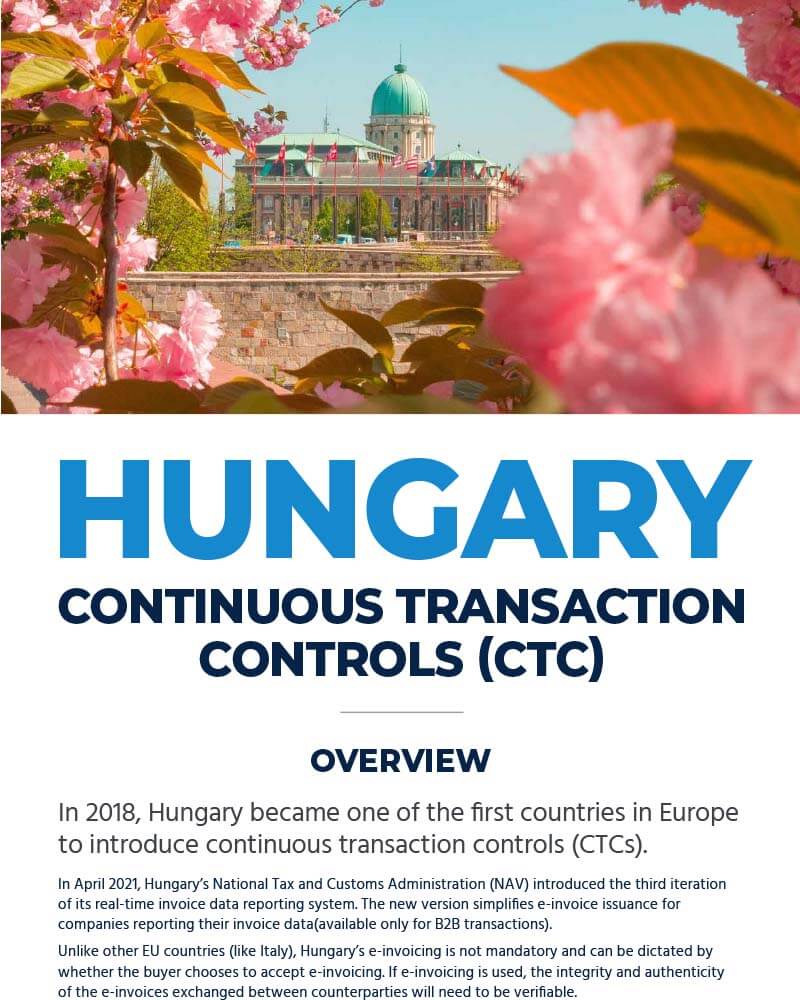
In 2018, Hungary established a legal framework requiring taxpayers to use a designed schema to report invoice data to the tax authority (NAV) in real-time for domestic transactions above a minimum VAT amount.
Due to the success of this measure, the scope of the mandate has been extended to include a wider range of transactions, and the earlier thresholds have been abolished. The impact of the mandate is now broadly felt in Hungary where all transactions between domestic taxable persons must be reported to the NAV, regardless of the amount of VAT accounted.
Have questions? Get in touch with a Sovos expert on RTIR Hungary.
Hungary VAT mandate quick facts
Immediate disclosure of data from all invoices issued under the scope of the mandate.
Once an e-invoice is issued, transmission of data must occur automatically using a machine-to-machine interface and must be done without human intervention
The transmission must include identification data and the obligatory data content as required under the Hungarian VAT Act.
VAT returns are filed monthly or quarterly and are due on the twentieth of the month after the end of the tax period.
The VAT return contains several appendices requiring additional information on transactions such as supplies of new means of transport and metals subject to the domestic reverse charge.
Alongside the VAT return, taxpayers must submit a summary report on all domestic purchases for which they’re claiming an input tax deduction.
Mandate rollout dates
1 July 2018: Mandate applies to all taxable persons to report invoice data in real-time to the National Custom and Tax administration of Hungary for domestic transactions with a minimum VAT amount of 100,000 HUF.
1 July 2020: The VAT threshold was abolished and all domestic transactions between taxable persons in Hungary must be reported regardless of the VAT accounted.
1 January 2021: Reporting obligations include B2C invoice issue and B2B intra-community supplies and exports.
1 January- 31 March 2021: The Ministry of Finance granted a sanction-free three-month grace period to comply with new reporting obligations and to give businesses time to transfer from the current version (v 2.0 XSD) to the new version v3.0 XSD.
1 April 2021: Mandatory usage of the new version (v3.0 XSD) begins.
RTIR Penalties
Failure to report the invoices in real-time could lead to an administrative penalty of up to 500,000 HUF per invoice not reported.
Additional penalties would apply for non-compliance with the invoicing software requirements.
Infographic
Hungary’s CTC Requirements
Understand more about Hungary’s NAV system, how to file invoices, when businesses are required to comply and how Sovos can help.
Sovos helps companies stay compliant with Hungary Real Time Reporting Requirements
As Hungary edges ever closer to CTC e-invoicing invoice clearance, Sovos enables businesses to stay up to date with the latest requirements and technical specifications so they can effectively connect with the NAV and honour their VAT compliance obligations.
The First Global Solution For E-Invoicing Compliance
Get ready for modern tax with Sovos eInvoice. Our e-invoice compliance solution ensures that you won’t have to worry about incorrect data holding up your compliance processes. This electronic invoicing software makes it possible to keep up with ever-changing international tax requirements so you’re always compliant no matter where you do business.
One platform for flexible, scalable e-invoicing
Global e-invoicing compliance
With the rapid pace of globalization, governments all over the world are now leveraging technology to close tax loopholes. Though each country differs in specific requirements, the shift toward real-time e-invoicing is transforming business-to-government compliance at every point in the supply chain–and leaving businesses scrambling to turn continuous tax compliance to their advantage.
Compliance-related issues and errors can cost you time and eat into your profits. Accuracy is more important than ever.
Sovos eInvoice simplifies global e-invoicing compliance, supported by our in-depth local knowledge to keep you up to date in today's constantly changing regulatory environment.
AR & AP invoice management
Manage accounts receivable and accounts payable invoicing mandates within one platform and stay compliant with both processes, when submitting invoices to clients, and validating invoices when received from suppliers.n
VAT Reporting
Guarantee compliant VAT reporting by using the same data set of both AR and AP process. You can always have VAT-compliant invoices with the help of this software.
Data extraction & mapping
Identify all fields required for fiscal compliance and map them to the correct XML schema defined by the local tax administration for tax-compliant invoices.
Global transmission & government connectivity
Connect to more than 60 tax administrations covering B2B and B2G requirements with a secure, certified connection through our e-invoice services.
Validation
Analyze issued and received invoices and syntactically validate them to ensure the XML document meets local tax authorities' technical specifications.
Invoice monitoring
Track invoice statuses and rejection notices, view audit trail, and view attachments in both XML and PDF formats. You'll also get visibility into invoices and report statuses all within one platform, so your team can minimize errors and risks, and monitor approved and rejected invoices.
Automated printing
Output legal invoices, including requirements for logo, special bar codes and signing data.
Guarantee authenticity & integrity
Ensure invoices have digital certificates delivered by certified authorities who are accredited by local tax authorities.
Flexible end-to-end integration with any ERP
Establish data integration processes with internal systems to automate the issue and receipt of all invoices. Solution adaptability lets you drive integration with any ERP on the market.
Contingency management
Guarantee your business operations will continue despite any government system failure.
Invoice automation
Streamline your processes and prevent human error from creating issues with the help of our e-invoice management solution.
Note: On 15 October the French Tax Authorities (DGFiP) announced that that the PPF’s role has been significantly reduced and they will no longer handle the exchange of invoices for all companies across the country. As such, all companies are now required to select a PDP. Find out what this means for businesses in our blog.
France’s e-invoicing mandate, combined with the e-reporting obligation, provides the tax authorities with access to transaction data. This is to increase efficiency, cut costs and fight fraud. Whether you are a buyer or supplier, the mandate’s effect on businesses and their operational processes, financial systems and people is extensive.
This France e-invoicing guide will explain:
How e-invoicing in France works
Who needs to comply and when
Key information about penalties and non-compliance
E-invoicing in France: Requirements and regulations
The e-invoice mandate is a model based on registered certified service providers connecting taxpayers to a centralized platform (Chorus Pro).
The structure of the e-invoices can be UBL, CII or Factur-X (a mixed format) or any other structured format. Also, during a transitional period (up until December 2027), taxpayers may submit their invoices in an unstructured PDF format.
E-invoices must contain all existing tax mandatory fields as well as those required by commercial laws, including line-item details (and for line-item data from January 2026). The invoice must mention the operation type (goods, services, mixed) and the VAT payment option. The inclusion of additional mandatory fields in e-invoices is a requirement. Accepted formats include structured and hybrid (image + structured data).
Exchanging e-invoices directly between trading parties is not allowed. Invoices must be exchanged betweenparties through certified service providers to the buyer party.
Payment status data for each service invoice is shared.
E-reporting frequencies are based on the VAT regimes that taxpayers are subject to.
E-invoicing and e-reporting in France: Implementation timeline
August 2023: The French Directorate General of Public Finances (DGFiP) postponed the implementation of the country’s e-invoicing mandate
December 2023: The Finance Law for 2024 is adopted, establishing new implementation dates for the e-invoicing mandate
June 2024: French authorities published a new version of the e-invoicing mandate External Specifications file
2025: Pilot phase expected to begin
September 2026: first phase of mandate to be enforced, mandating inbound e-invoicing for all companies and outbound e-invoicing and e-reporting for large & mid-sized businesses
September 2027: Second phase of mandate to be enforced, mandating outbound e-invoicing and e-reporting for all other companies
Register for e-invoicing in France with Sovos
Sovos can help your business comply with the French mandate with a range of services:
Tax compliance services – to control, sign, archive and format invoicing data according to the legal requirements as well as create SAF-T (FEC) reporting for both suppliers and buyers
Sovos PDP – Sovos is a confirmed Partner Dematerialization Platform (PDP)
Connectivity services – through Sovos or via our partners to deliver e-invoice, e-reporting and lifecycle status data
France’s e-reporting requirements are established alongside the new e-invoicing mandate, with the reporting frequency based on the taxpayers’ applicable VAT regime. The e-reporting requirement will complement the e-invoicing mandate by facilitating the transmission of data on B2C transactions or supplied to foreign entities.
In France, an electronic invoice is defined as an invoices which is issued and transmitted in paperless form, following a structured format.
France’s e-invoicing requirements come into effect during 2026-2027, depending on business size. However, from September 2026, all companies must be able to receive e-invoices.
Exchanging e-invoices directly between trading parties is not allowed. Originally it was intended that either a registered service provider (PDP) or the centralized platform (Portail Public de Facturation – PPF) would transmit the e-invoice to the buyer party, which would then be able to leverage either a PDP or the PPF for receiving the invoice.
However, the French Tax Authorities announced on 15 October that the PPF’s role has been significantly reduced and they will no longer handle the exchange of invoices for all companies across the country. As such, the French State’s “own free-of-charge” PDP utility service will not become available to French businesses.
Therefore, all companies in scope are required to select a PDP. Without the PPF being available as a free invoice exchange platform, it is estimated that 4+ million companies will now have to rely on PDP-enabled accounting software to receive those transactions.
PDPs are private service providers accredited by the tax authority to intermediate data flows between trading partners and the PPF. They will act as the interface between companies and the French government and will be directly involved in issuing and receiving invoices. Following the announcement, on 15th October 2024, that the PPF will no longer be acting as a free invoice exchange platform, all companies in scope are required to select a PDP.
On Monday 26 August 2024, the French Tax Authority officially confirmed Sovos as a Partner Dematerialization Platform (PDP). This authorization comes after a rigorous application and review process. Read more in the press release.
There are a growing number of tax authorities that have implemented e-invoicing globally, including France, Italy, Saudi Arabia and India. There are also many countries working on implementing e-invoicing including Germany and Spain.
Italy was the first country in the region to introduce a clearance e-invoicing model with the Sistema di Interscambio (SdI) platform. Seeking to close one of Europe’s most significant VAT gaps, the government has steadily improved its Continuous Transaction Controls (CTC) system.
Beginning with B2G e-invoicing in 2014 and extending to cover domestic B2B and B2C e-invoices in 2019, Italy became the first EU country to make B2B e-invoicing mandatory through a clearance process.
This page will:
Explain how Italy’s e-invoicing works
Help you understand how to comply with the e-invoicing regulations
Answer your questions about the Sistema di Interscambio
Have questions? Get in touch with a Sovos Italy e-invoicing expert.
Issuing e-invoices requires creation in a structured format and transmission is via the Sistema di Interscambio
The Fattura PA – the tax authority’s XML schema format – is the required format for issuing e-invoices
For B2B e-invoices, businesses can choose how to ensure the integrity and authenticity of invoices, but there is a strong market preference for Qualified Electronic Signatures. However, B2G e-invoices must be electronically signed.
Exchange of National Health Service purchase orders is through the NSO platform and referenced accordingly in the e-invoice.
E-archiving invoice requirements include the obligation to:
Execute a signing and time stamping process for e-invoices in an archive
Maintain a documented description of the archive and the archiving process (Manuale della Conservazione)
Put in place a clear delegation plan setting up the responsibilities around the archiving process
Since 1 July 2022, all cross-border transactions must be reported through the SdI in the FatturaPA format. Taxpayers can continue to exchange cross-border invoices in any agreed way.
Scope of e-invoicing in Italy
B2B e-invoicing in Italy applies to:
Domestic B2B transactions between Italy resident/established taxpayers
Almost all Italy resident/established taxpayers
Included in 2022: Taxpayers who adopt the flat-rate tax regime (regime forfettario) and amateur sports associations and third sector entities with revenue up to EUR 65,000
From 1 Jan 2024: Microenterprises with revenues or fees up to EUR 25,000
B2G e-invoicing in Italy applies to:
All taxpayers supplying goods/services to public administration entities
E-invoicing in Italy: Mandate Rollout Dates
6 June 2014: Phased roll-out of mandatory B2G e-invoicing starts in Italy
1 July 2018: Clearance mandate goes into effect for manufacturers and distributors of petrol and diesel intended for use as a motor fuel in cars and road vehicles
1 September 2018: Mandate starts for tax-free sales to non-EU individuals acting as final customers
1 January 2019: Mandate becomes a requirement for domestic B2B and B2C transactions in Italy, with minor sector-specific exceptions
1 February 2020: Exchange of purchase orders for the supply of goods to entities associated with the National Health Service through the NSO platform becomes compulsory and reference in the e-invoice becomes a requirement
1 January 2021: Introduction of pre-populated VAT returns and enforcement of new FatturaPA schema
June 2021: Enforcement of the new requirements for the creation and archiving of electronic documents
October 2021: Voluntary transition phase for e-invoicing between Italy and San Marino began
1 July 2022:
Italian businesses must report information on cross-border transactions to the SDI in the FatturaPA format. As a result, Esterometro was abolished on 30 June 2022
E-invoicing using the FatturaPA format becomes mandatory between Italy and San Marino, with the Italian SdI as the access point for Italian taxpayers and the HUB-SM platform as the SdI counterpart on San Marino’s side
Scope of the B2B e-invoicing mandate in Italy broadened to include:
Taxpayers who adopt the flat-rate regime (regime forfettario)
Amateur sports associations and third sector entities with revenue up to EUR 65,000
January 2024: E-invoicing scope to include microenterprises with revenues or fees up to EUR 25,000
1 July, 2030: Italian VAT-registered businesses must comply with VAT in the Digital Age (ViDA) requirements, which include mandatory e-invoicing and digital reporting for Intra-Community B2B transactions.
Penalties: What happens if you don’t comply
Failure to issue an invoice or issuing an invoice that doesn’t meet the XML format will result in a penalty between 90-180% of the associated VAT amount.
Issuing a purchase invoice to a client without adhering to mandate requirements will result in a penalty of 100% of the associated VAT amount.
After a grace period (expired for the supply of goods and services), there will be no payment for invoices issued to entities associated with the National Health Service if no prior purchase order has been transmitted through the NSO platform and referenced in the e-invoice
Register for e-invoicing in Italy with Sovos
Sovos ensures compliance with all SdI e-invoicing and VAT requirements in Italy including CTC e-invoicing, reporting and e-archiving. All you need to do is work with us and you can use our solution that connects directly with the SdI.
E-invoicing in Italy is mandatory for the majority of the B2B, B2C and B2G invoices. Suppliers performing activities classified as “Commercio al minute e attivitá assimilate” are exempt from the obligation of issuing e-invoices, unless their customers so request them; on the other hand, those suppliers are required to electronically transmit a daily aggregate report (It.: Scontrino Elettronico). Reporting of cross-border transactions through the SDI in the FatturaPA format is also mandatory.
How does e-invoicing work in Italy?
The tax authority requires all invoices in the Fattura PA XML schema format. Transmission of e-invoices happens through the Sistema di Interscambio. E-invoices must be cleared by the tax authority. The Italian tax authority delivers the legal cleared e-invoice to the recipient.
How do you securely connect with the SdI to issue invoices?
With ease. Our solution connects securely with the SdI, freeing you from the burden of knitting together different systems and platforms.
How do you comply with Conservazione sostitutiva?
The term conservazione sostitutiva refers to a long-term preservation process required for compliant archiving of e-invoices in Italy. E-invoices must be preserved after being archived by grouping them together in a so-called ‘package’, and providing that e-invoice package with a qualified digital signature or seal and a time reference.
This process must be completed no later than three months after the deadline for the submission of the annual fiscal declaration at the end of the fiscal year. E-invoice preservation is an integral feature of Sovos eArchive for invoices stored under Italian law.
While many governments and tax authorities are now on an e-Transformation journey, this trend began in Latin America in the early 2000s. Turkey followed suit a decade later when it began the digitization of its tax system.
Turkey is further along in its e-Transformation journey than most countries – including EU Member States, which are working towards digitization in their own way with the overarching VAT in the Digital Age initiative.
From e-invoicing to electronic self-employment receipts, Turkey now has a fully-fledged, established digital tax system with many moving parts. To understand Turkey’s e-Transformation, bookmark this page then read on.
CTC Type E-invoice clearance with both parties registered on the portal
Network Centralised – e-Fatura Portal delivers the e-invoices to Buyers for B2B transactions
Format UBL-TR format
eSignature Requirement Required – fiscal stamp or qualified electronic signature
Archiving requirement 10 years
E-arşiv Fatura Turkey
CTC Type E-invoice reporting (daily basis)
Network Decentralised – e-Fatura Portal does not deliver e-arşiv invoices; it’s the taxpayers’ responsibility
Format UBL-TR format or in a free format such as PDF and must also be available in paper form
eSignature Requirement Required – fiscal stamp or qualified electronic signature
E-Transformation in Turkey
Turkey stepped up its tax system through digitization in 2012 to help important information be gathered and transmitted with ease and accuracy. It’s further ahead than many other countries, with a variety of electronic systems and documents mandated for many taxpayers – all starting with its e-Ledger obligation.
Turkey joined the eEurope+ initiative and moved fast to ensure it was keeping up with tax digitization efforts, relieving its entire economic ecosystem where information is concerned. The aims of such changes are to reduce VAT fraud, increase governmental access to and control of data, standardise financial and accounting processes and reduce errors.
Now effectively utilising electronic versions of invoices, ledgers, delivery notes, self-employed receipts and more, there are a lot of challenges for taxpayers to overcome to remain compliant amidst Turkey’s e-Transformation.
Turkey’s ambition to electronically transform its tax ecosystem required the development and implementation of many products and services. This presented taxpayers with new requirements and, subsequently, new challenges.
Here are the products and services in Turkey’s e-Transformation system:
e-Fatura
e-Fatura is Turkey’s e-invoicing initiative. Mandated for companies with turnovers of over TRY 5 million, this obligation came into effect on 1 April 2014. There are also sector-based parameters for the nation’s e-invoicing mandate, ignoring the turnover threshold, qualifying the following for an electronic invoice obligation:
Companies licensed by the Turkish Energy Market Regulatory Authority
Middlemen or merchants trading fruits or vegetables
Online service providers facilitating online trade
Importers and dealers
Turkey’s e-invoicing initiative is a clearance model and two-way application, with issued invoices needing to be in the UBL-TR format and archived for 10 years. Sovos’ e-invoice solution enables compliance with e-Fatura requirements.
e-Arşiv Fatura
e-Arşiv Fatura is Turkey’s e-arşiv invoice initiative. Taxpayers registered in the e-Fatura system must also issue e-Arşiv invoices, either in the UBL-TR format or in a free format such as PDF.
Real-time clearance is not conducted for the issuance of these invoices, though an e-Arşiv report must be submitted electronically to the tax authority by the end of the following day. e-Arşiv invoices are always created electronically but must be available in paper form unless the buyer agrees to receive the document electronically.
e-İrsaliye is Turkey’s e-WayBill initiative. The use of e-İrsaliye documents became obligatory for taxpayers that surpass the TRY 10 million revenue threshold on 1 July 2023, though those outside of the scope can voluntarily switch to electronic WayBill documents.
There are two types of paper waybills, namely shipment and transportation. e-İrsaliye largely replaces the shipment waybill.
Information required in this type of e-document includes:
Supplier information
Issue date and document number
Buyer information
Type and quantity of the transported goods
Shipment date and time
Legally, there is no difference between paper waybills and eWayBills, though the electronic version requires both parties to be registered in the national system.
e-Defter
e-Defter is Turkey’s e-Ledger initiative. The Turkish tax authorities made the e-Ledger application mandatory for e-invoice users and taxpayers, subject to independent audit, in 2015.
These e-documents must be prepared in XBRL-GL format and include specific information in standard XML format – all signed with a financial seal. In addition to producing e-ledgers, taxpayers are required to create a ledger summary which is to be sent monthly to the TRA and archived for 10 years.
Electronic ledgers reduce the time it takes to collect data, save costs associated with the notarization process and ensure compliance with tax processes.
e-Mutabakat
e-Mutabakat is Turkey’s e-Reconciliation initiative. Reconciliation is the communication between accounts to mutually agree on the debit and credit between companies that are part of an agreement.
Turkey’s tax authority has ruled that companies are obliged to make reconciliations at particular times. The last day of the year is typically the day when the account between two parties will be closed unless an agreement or legal requirement states otherwise.
The BA-BS web application developed by the TRA for e-Reconciliation enables taxpayers to compare current agreements and unbalanced agreements before electronic submission of the BA-BA forms.
e-Müstahsil Makbuzu
e-Müstahsil Makbuzu is Turkey’s e-Producer Receipt initiative. This commercial e-document is issued by farmers or wholesalers to keep a record of the products they buy from farmers that don’t bookkeep.
Taxpayers that are obliged to issue producer receipts have had to issue electronic versions of the document, known as e-Müstahsil Makbuzu, since 1 July 2020. However, fruit and vegetable brokers or merchants have been required to issue e-Producer Receipts since 1 January 2020.
Those obliged to utilise e-Producer Receipts may be outside of the scope of e-Fatura, e-Arşiv Fatura and e-Defter requirements.
e-Serbest Meslek
e-Serbest Meslek is Turkey’s e-Self-Employed Receipt (e-SMM) initiative. This obligation came into effect on 1 February 2020 and applies to all self-employed individuals, including:
Architects
Engineers
Financial advisors
Lawyers
Screenwriters, writers, composers and painters
Self-employed doctors, dentists and veterinarians
e-SMM receipts can be created, submitted and reported electronically and carry the same legal weight as paper Self-Employment Receipts. They must be archived for 10 years.
While all the above are prominent e-documents, there are even more electronic documents in Turkey that you should know about. To learn more, read our e-documents overview.
Who is affected by e-Transformation?
E-Transformation includes many documents, each subject to specific thresholds and criteria based on their type. Additionally, certain documents are mandatory for particular sectors without any threshold criteria. E-invoicing is now mandatory for the majority of taxpayers, but it is important to understand which documents are required to be submitted to the tax authorities.
The TRA continues to announce new taxpayer groups in scope of the different document types, so it’s important that businesses stay up to date with the latest information to ensure they remain compliant.
What are the benefits of e-Transformation?
Turkey’s tax transformation aimed to deliver benefits to both the government and taxpayers.
The e-Transformation initiative aims to produce the following benefits:
Real-time collection of financial data
Reduce VAT fraud and the circulation of fake invoices
Increased standardisation to automate accounting processes
Improved efficiency and reduction of manual errors through data auto-population
Tax compliance and e-Transformation
Turkey’s e-Transformation has impacted tax compliance, successfully implementing real-time transmission of important financial data.
With data automatically being populated in documents, it reduces the possibility of error via manual input and fraudulent invoices being submitted. The reduction of the VAT gap has been a driving force for many countries, including Turkey.
Eliminating paper, cartridge, shipping and archiving costs associated with paper invoices is also an advantage to businesses and government.
With over 16 document regulations, Turkey’s e-transformation system requirements are extensive and complex. Understanding which regulations apply and keeping up with the latest tax compliance guidelines is key.
How Sovos can help with your e-Transformation journey
Sovos provided the first global e-Transformation solution suite, helping businesses of all shapes and sizes to meet the demands of Turkish tax mandates. Our platform meets all the requirements, standards and formats defined by the Turkish Revenue Authority.
Organisations choose Sovos as their global compliance partner, partly due to the convenience of having a single vendor to aid compliance wherever and however they do business.
A special integrator is an intermediary service provider authorised by the Turkish Revenue Administration. Special integrators have the authority to create electronic records on behalf of taxpayers.
The General Authority of Zakat and Tax’s (GAZT) previously published draft rules on ‘Controls, Requirements, Technical Specifications and Procedural Rules for Implementing the Provisions of the E-Invoicing Regulation’ aimed to define technical and procedural requirements and controls for the upcoming e-invoicing mandate. GAZT recently finalized and published the draft e-invoicing rules in Saudi Arabia.
Meanwhile, the name of the tax authority has changed due to the merger of the General Authority of Zakat and Tax (GAZT) and the General Authority of Customs to form the Zakat, Tax and Customs Authority (ZATCA).
The finalised rules include a change to the go live date of the second phase from 1 June 2022 to 1 January 2023. They revealed the time limit to report B2C (simplified) invoices to the tax authority´s platform for the second phase.
According to the final rules, the Saudi Arabia e-invoicing system will have two main phases.
Saudi Arabia E-Invoicing System: The First Phase
The first phase begins on 4 December 2021 and requires all resident taxpayers to generate, amend and store e-invoices and electronic notes (credit and debit notes).
The final rules state businesses must generate e-invoices and their associated notes in a structured electronic format. Data in PDF or Word format are therefore not e-invoices. The first phase does not require a specific electronic format. However, such invoices and notes must contain all necessary information. The first phase requires B2C invoices to include a QR code.
There are a number of prohibited functionalities for e-invoicing solutions for the first phase:
Uncontrolled access
Tampering of invoices and logs
Multiple invoice sequences
Saudi Arabia E-Invoicing System: The Second Phase
The second phase will bring the additional requirement for taxpayers to transmit e-invoices in addition to electronic notes to the ZATCA.
The final rules state the second phase will begin 1 January 2023 and will be rolled-out in different stages. A clearance regime is prescribed for B2B invoices while B2C invoices must be reported to the tax authority platform within 24 hours of issuance.
As a result of the second phase requirements, the Saudi e-invoicing system will be classified as a CTC e-invoicing system from 1 January 2023. All e-invoices must be issued in UBL based XML format. Tax invoices can be distributed in XML or PDF/A-3 (with embedded XML) format. Taxpayers must distribute simplified invoices (i.e. B2C) in paper form.
In the second phase, a compliant e-invoicing solution must have the following features:
Generation of a Universally Unique Identifier (UUID) in addition to the invoice sequential number
Tamper-resistant invoice counter that increments for each invoice and electronic note issued
Contain some functionalities which enable taxpayers to save e-invoices and electronic notes and archive them in internal and external archive
Generation of a cryptographic stamp for each e-invoice or electronic note
Generating a hash for each generated e-invoice or electronic note
Generation of a QR code
The second stage will furthermore bring additional prohibited functionalities for e-invoicing solutions on top of requirements mentioned in the first phase:
Time change
Export of stamping key
What’s next for Saudi Arabia’s e-invoicing system?
After publishing the final rules, the ZATCA is organising workshops to inform relevant stakeholders in the industry.
Some of the details remain unclear at this point, however the Saudi authorities have been very successful in communicating the long-term goals of the implementation of its e-invoicing system, as well as making clear documentation available and providing opportunities for feedback on the documentation published for each phase. We expect provision of the necessary guidance within the near future.
Manage Your CTC Obligations with a Global Compliance Solution Built On Local Expertise
Automate your CTC compliance management
Standardize on tax technology with continuous legal monitoring to power compliance across all business processes.
Tax administrations continue to insert themselves into the invoicing process or demand detailed records within a matter of hours or days of transactions. Sovos empowers you to comply with a cost-effective, secure, global solution to withstand the disruption of this global continuous transaction controls (CTC) trend.
Adopt a consistent global compliance strategy that scales across all jurisdictions and enterprise systems by connecting flexibly to a single provider, regardless of legal and business changes. Sovos’ VAT Compliance Solution Suite includes CTC services such as reporting and e-invoicing as integral components of a fully scalable solution suite and includes Sovos Periodic Reporting, SAF-T and Sovos eArchive.
Put CTC compliance in your digital financial core.
Stay ahead of current and future compliance obligations.
Monitor 60+ countries to track the diverse range of emerging legal frameworks and evolving specifications.
Simplify compliance vendor relationship management with a single, global point of contact.
Ensure invoices continue to flow, so your business and its supply chains run smoothly.
Minimize the need for ad hoc IT involvement and investment in compliance updates.
Save time, eliminate labor-intensive manual updates, and enhance accuracy.
Stop worrying about ever-changing different country formats and processes.
Reduce your total cost of compliance.
Managing CTC obligations
A complete global VAT compliance solution
Ease your journey to CTCs with Sovos for a scalable global VAT compliance solution built on local expertise to solve your CTC management obligations wherever you operate.
Learn more
Benefits of Sovos CTC software for SAP users
Shield ERP custom-code from change.
Empower customers to handle current and future CTCs.
Maintain ERP as a single source of truth by automating the alignment of transactional data between customer ERP and government systems.
Match acknowledgement / approval / rejection codes to original invoices and near real-time reports submitted.
The Turkish Revenue Administration (TRA) has published updated guidelines on the cancellation and objection of e-fatura and e-arsiv invoice. Two different guidelines are updated: guidelines on the notification of cancellation and objection of e-fatura and guidelines on the notification of cancellation and objection of e-arsiv.
The updated guidelines inform taxable persons about the new procedures for objection against an issued e-fatura and e-arsiv invoice. And how this must be notified to the TRA. Due to changes in the objection procedure, the e-arsiv schema has also changed. There has not yet been a change in the e-fatura schema, however it could also change in the near future. The updated guidelines state that the TRA platform can be used to notify the TRA about objection requests made against an issued e-fatura and e-arsiv invoice.
Why are the updated guidelines important?
From July 2021, electronically issued documents won’t be mentioned in the so called ‘BA and BS forms’. The BA and BS forms are generated to periodically report issued or received invoices when a total invoice amount is 5.000 TRY or more. All limited liability and joint stock companies are obliged to create and submit the forms to the TRA even if they don’t have any invoices to report.
The TRA recently published a new provision stating that electronically issued documents will not be shown in BA and BS forms and instead will be reported directly to the TRA in the clearance (e-fatura) and reporting(e-arsiv) process. Considering that the TRA receives the invoice data for electronically issued invoices in real-time, relieving taxpayers from reporting invoices through BA and BS forms creates a more efficient system in which the relevant data will be collected only once from taxpayers.
At its current stage, e-documents won’t be mentioned in these forms. However, in order for the TRA to have accurate invoice data about each taxpayer, it needs to be notified which are the final invoices and disregard any objected or cancelled documents when evaluating taxpayer data.
Although the cancellation process is already performed through the TRA platform for basic e-fatura and e-arsiv, objection requests are made externally (through a notary, registered letter or registered e-mail system), meaning the TRA does not have visibility of all objections. There could therefore be a risk that the TRA considers a cancelled document (due to objection) as issued which could result in discrepancies between the taxpayer records and the data that the TRA considers relevant for tax collection.
Therefore, taxpayers must now notify the TRA about objection requests to avoid any discrepancies between their records and BA and BS forms. The final goal of this application is that the BA and BS forms will be completely auto populated by the TRA in future.
How will the new process work?
According to the Turkish Commercial Code, any objections or cancellation requests must be made within eight days. Suppliers and buyers can raise an objection request which must be made externally (through a notary, registered letter or registered e-mail system) and registered in the TRA system.
For e-arsiv application, there are two ways for suppliers to notify the TRA about the objection request. They can either use the e-arsiv schema (automated) or register the request in the TRA portal. Buyers can see this request on the TRA platform and may respond, although they are not obliged to. Because e-self-employment receipts are also reported through e-arsiv application, the same objection rules apply.
For e-fatura, since there is no change in the schema, it is not possible for suppliers or buyers to notify the TRA using e-fatura schema. Currently, they can only notify the TRA about e-fatura objections through the TRA platform. Taxpayers can also respond to objection requests only through the platform.
What’s next?
The TRA has taken a step towards the digitalization of cancellation and objection requests. However, there is still not an automated way to perform these actions. Before the digitized objection process becomes reality in the country, the authorities must take a more sophisticated approach towards automating the process as well as introducing or amending applicable legislation.
Take Action
Get in touch to find out how Sovos tax compliance software can help you meet your e-transformation and e-document requirements in Turkey.
The Colombian electronic invoicing system is reaching maturity level. Since its inception in 2018, Colombia has been steadily consolidating and expanding the mandate to make it more stable, reliable and comprehensive.
As a result of the enactment of the recent Resolution 000013/2021, the Colombian tax administration (DIAN), officially expanded the electronic invoicing mandate to also include payroll transactions. This expansion follows the pattern established by Mexico, Brazil and other countries that already expanded the electronic invoicing mandate to payroll transactions as well.
The Support Document for Electronic Payroll is known locally in Colombia as Documento Soporte de Nomina Electronica or also simply as Nomina Electronica. It is a new digital document intended to support and validate the payroll related costs and deductions of income tax and the VAT credits (if applicable) when businesses make payments resulting from labor, legal, and other similar types of relations (pensions).
In simple terms, labour cost transactions should be reported under this new digital system for them to be valid. This is whenever employers make payments for wages, salaries, reimbursements, pensions etc.
Who is required to comply with the electronic payroll mandate?
Employers paying wages under a labor relation, where payments are reported as expenses for income tax purposes or as deductible taxes for VAT, need to comply. However, there are important exceptions derived from that legal framework. For instance, public offices, non-for-profit entities or taxpayers under the simplified regime are not currently required to comply. Consequently, they do not need to use such payments for deductions of income tax or VAT.
Schedule of deployment
The DIAN established an implementation schedule based on the number of employees the taxpayer has in the payroll. There are four stages or groups subject to the following deadlines:
Group
Deadline to start the generation and remittance of the document
Number of employees
From
Up to
1
1 September 2021
More than 250 employees101
2
1 October 2021
101
250
3
1 November 2021
11
100
4
1 December 2021
1
10
Deadline for remittance
As the Nomina Electronica is required to be reported monthly, the payments for each month should be reported by the 10th day of the next month as a result. The adjustment notes should be reported within the same deadline, once they have been made by the employer.
Reporting elements of the electronic payroll mandate
There are two basic types of reports that are parts of this mandate: the Support Document of the electronic payroll, and – when necessary – the Adjustment Note.
Support Document of Electronic Payroll or Nomina Electronica
This electronic document contains the information supporting the payments made to employees as wages and other compensations, deductions and the difference between them made by the employer, as reported in the payroll. The employer must then generate and transmit the document to the DIAN using the XML format established in the technical documentation included in the regulation 000037/2021.
Adjustment Notes
In this mandate there are no credit notes as we know them in the electronic invoice system of Colombia. However, when an employer needs to make corrections to the Support Document of Electronic Payroll reported to the DIAN, it can issue what we know as Adjustment Notes (or Notas de Ajuste) where the employer will be allowed to correct any value previously reported to the DIAN via the Nomina Electronica.
Content and structure of the reports
Employers must submit reports to the DIAN individualised for each beneficiary receiving payments from the employers. As a result, the report requires the provision of some mandatory information for the DIAN to validate. This includes the proper identification of the report itself, the reporting party, in addition to the employees, wages or other payments employees, date, numbering, software etc.
Another mandatory information element that is worth mentioning is the CUNE or Unique Code of Electronic Payroll Support Document. This is a unique identifier for each Electronic Payroll Support Document. It will allow exact identification of each report or the Adjustment Notes issued after it. However, there is some additional optional information that can be provided depending on the needs or convenience of the employer making the report.
From a technical perspective, neither the Support Document of the Electronic Payroll nor the Adjustment Notes are based on the UBL 2.1 structure used in Colombia for the electronic invoice. This is because the UBL standard does not include modules for payroll transactions or reports. Therefore, the DIAN has based its architecture in a different XML standard. Each report requires a digital signature. For that, the taxpayer can use the same digital certificate used for signing electronic invoices.
Generation, transmission and validation
The current regulations do not require that the Nomina Electronica or the Adjustment Notes should be generated by a particular software solution or by a software provider authorized by the DIAN. Taxpayers have the option to generate the report using their own solution. That is a market solution or a solution that the DIAN will provide for small taxpayers. However, all reports should strictly follow the technical documentation issued by the DIAN within the Resolution 000037/2021. The remittance of those documents is electronic, using the webservices specified by the DIAN.
After making the transmission, the DIAN then validates the document. They will then report back the corresponding application response to the taxpayer, indicating its acceptance and validation. Only then, will the amounts reported in the payroll document are valid expenses for the deduction.
Penalties and sanctions
Non-compliance with electronic payroll in Colombia will be subject to the same fines and penalties established for not complying with the electronic invoicing mandate, as defined in Art. 652-1 of the Tax Code of Colombia (Estatuto Tributario). But the most important implication of non-compliance is that any payment not reported by the employer, will not be allowed as expenses for income tax or VAT purposes when applicable.
An amendment in the General Communiqué No. 509 has announced healthcare service providers and taxpayers providing medical supplies and medicines or active substances must use the e-invoice application from 1 July 2021.
The mandated scope for transition to e-invoice and e-arşiv invoice applications in the healthcare industry
Published in the Official Gazette the implementation will cover healthcare service providers who have signed contracts with the Social Security Institution (SSI) and all taxpayers providing medicines and active substances and medical supplies.
This includes:
Hospitals, medical centres, branch centres, dialysis facilities
Other specialised treatment centers licensed by the Ministry of Health
Diagnosis, medical examination and imaging centres
Laboratories, pharmacies, medical device and material suppliers
Optometry organisations, auditory centres, spas
Private legal entities providing or producing human medicinal products, in addition to their unincorporated branches and pharmaceutical warehouses.
The transition process to e-invoice and e-arşiv invoice applications in the healthcare industry
Within this scope, organisations must use the e-invoice application as of 1 July. Organisations signing contracts with SSI after this date must use e-invoice prior to their issue of invoices to SSI.
From 1 January 2020 all organisations included in the e-invoice application scope have to apply the e-arşiv invoice on the date of e-invoice application. Any healthcare organisations included in the amendment will then have to apply the e-arşiv invoice on 1 July.
What are the benefits of e-invoice and e-arşiv invoice transition to the healthcare industry?
The digitisation process will minimise physical contact, a significant benefit following the Covid-19 outbreak. Furthermore, organisations will no longer have to prepare or store physical documents as they are stored electronically.
For organisations that issue invoices to SSI, transactions such as payment terms will become faster and more efficient via the e-invoice and e-arşiv invoice applications. In addition to the transfer of all invoice-related processes to the digital environment.
Organisations that carry out the e-issuance process via the TRA Portal or via a third-party integrator will benefit from easy access to documents, improved efficiency, and business continuity as a result.
Take Action
Get in touch to find out how Sovos tax compliance software can help you meet your e-transformation and e-document requirements in Turkey.
The new ‘Guidelines for the creation, management, and preservation of electronic documents’ (“Guidelines”) regulate different aspects of an electronic document. By following the Guidelines, businesses benefit from the presumption that their electronic documents will provide full evidence in court.
The postponement of the introduction of the Guidelines is a reaction from the AGID to claims of local organizations who have particularly expressed concern about the obligation to associate metadata with e-documents. The Guidelines set forth an extensive list of metadata fields for keeping alongside e-documents in a way that will enable interoperability.
Metadata requirements modified
In addition to delaying the introduction of the new e-document legislation, the AGID has also modified metadata requirements. They included new pieces of metadata and changing the description of some fields. The AGID has also corrected references – especially to standards – and rephrased statements to clarify some obligations.
The updated Guidelines and their corresponding Appendices are available on the AGID website.