Meet the Expert is our series of blogs where we share more about the team behind our innovative software and managed services.
As a global organisation with indirect tax experts across all regions, our dedicated team are often the first to know about new regulatory changes, ensuring you stay compliant.
We spoke to Wendy Gilby, technical product manager at Sovos, to find out more about her role developing Sovos’ Insurance Premium Tax (IPT) software to help customers meet the demands of a constantly changing regulatory environment.
How did you come to work at Sovos?
Prior to joining Sovos I worked at an investment bank in London, working my way up from trainee programmer to programmer, analyst, business analyst, systems analyst, project manager, global production support manager and eventually vice president.
Due to personal circumstances, I started working part time and was even briefly a rowing coach before heading back to university to complete a Computing and IT degree.
I was looking for another role in IT and originally worked for FiscalReps (now part of Sovos) on a short-term contract in 2016 or 2017. This is the product that we now know as Sovos IPT which needed testing to ensure it was fit for purpose.
After completing the project, I came back on a six month contract, which became a full-time permanent position and I’m still here today!
What is your role and what does it involve?
My role is to work out how to implement any modifications to the Sovos IPT system. We agree with the wider Sovos IPT team what new functionality or changes they want and work closely with the development team to convert the ideas into the solutions that our customers use.
I’ve recently been looking at the Sovos VAT solution to try and see the synergies between VAT and IPT in terms of user set up, user roles, uploading data, and initial validation on the files that we get from clients to improve the overall user experience for our IPT solutions.
What’s your team responsible for and how do they help customers?
We’re always trying to make the whole process of filing taxes more efficient, and a lot smoother for customers, whichever country they file their taxes in.
We’ve spent a lot of time refining the IPT Portal to make the process of filing and reporting IPT easier but also more compliant. We’re trying to eliminate as many of the manual steps involved in filing taxes as possible to reduce errors.
Sovos is a blend of technology and human expertise so we work closely with the compliance team who ensure reporting is accurate and compliant across all the tax authorities our customers file IPT in.
Our aim is to automate and integrate as much of the filing process as possible from data submission to receiving funds and submitting to the tax authorities to ensure we don’t miss any tax return dates and avoid late fees.
How are you using the latest technology to improve Sovos customers’ experience?
This probably ties into the work we’re doing on the IPT Portal. We’re trying to make everything more transparent so customers can see everything in one place including the status of their tax returns.
We’ve also introduced APIs as well, so customers can send us a file straight from their system, it’s a lot less hassle for them. We’re always focused on making it easier for customers to send us their data and providing as many options as possible to do this.
How have you seen the technology change since you joined Sovos? What has had the biggest impact?
I think the biggest impact has been the IPT Portal. When I started, much of the reporting processes were still paper based which meant a lot of sifting through paper tax return documents for the compliance team ahead of filing.
So having the IPT portal with all the documents that used to be printed out in one place, where clients can view everything online, has been the biggest change and one that our customers and our compliance team value, especially over the past year when companies have had to adapt to working remotely and not having as easy access to resources in the office.
What particularly excites you about future tax technology?
I think it’s the move towards a more connected reporting processes, joining all these disparate elements of tax returns to make the IPT reporting and filing process even easier and far less error-prone. As certain elements still require some manual input there’s still opportunities for mistakes so eliminating this concern altogether and making it a simple process from initial upload to submission to the tax authorities is really exciting.
Automated returns are becoming more prevalent and we’re in the process of working on these for Germany, France and Hungary so when I say future it’s actually already happening which is very exciting.
More than 170 countries throughout the world have implemented a VAT system, and some of the most recent adopters are the Gulf countries. In a bid to diversify economic resources, the Gulf countries have spent the past decade investigating other ways to finance its public services.
As a result, in 2016 the GCC (Gulf Cooperation Council), consisting of Saudi Arabia, UAE, Bahrain, Kuwait, Qatar and Oman, signed the Common VAT Agreement to introduce a VAT system at a rate of 5%.
The first step: VAT adoption across the GCC
Following the VAT agreement, Saudi Arabia and UAE implemented VAT in 2018. Bahrain followed with a VAT regime in 2019. Most recently Oman enforced a 5% VAT from April 2021, and looking ahead both Qatar and Kuwait are expected to enact VAT laws within the next year.
The second step: VAT digitization
After the implementation of VAT and the increase of VAT rate from 5% to 15%, Saudi Arabia has taken the next step to digitize the control mechanisms for VAT compliance.
The E-invoicing Regulation enacted in December 2020 sets out an obligation for all resident taxable persons to generate and store invoices electronically. This requirement will be enforced from 4 December 2021.
Saudi Arabia has made considerable progress since it first introduced VAT in 2018. The Saudi E-invoicing Regulation is expected to not only encourage digitization and automation for businesses, but also to achieve efficiency in VAT controls and better macro-economic data for its tax authority, a development which will likely be replicated by other GCC countries soon.
Considering the efforts involved in the digitization of government processes and the VAT implementation timeline, the next candidate for similar e-invoicing adoption would likely be the UAE. While there are currently no plans for a mandatory framework, the UAE has announced bold plans for general digitization. According to the UAE government website, “In 2021, Dubai Smart government will go completely paper-free, eliminating more than 1 billion pieces of paper used for government transactions every year, saving time, resources and the environment.”
The spread of VAT digitization is typically the second reform following VAT adoption. As Bahrain and Oman also have VAT systems in place, introduction of mandatory e-invoicing in the next a few years in these countries would not come as a surprise. The adoption of e-invoicing in Qatar and Kuwait would depend on the success of VAT implementation, therefore it is not easy to estimate when their VAT digitization journey will begin but there is no doubt that it will happen at some stage.
The next step for VAT adoption across the GCC
After the adoption of e-invoicing, the Gulf countries may continue to digitize other VAT processes, including VAT returns. Pre-population of VAT returns using the data collected through e-invoicing systems is another trend that the countries are moving towards.
Regardless of the shape and form of digitization, there will be many moving parts in terms of VAT and its execution. Businesses operating in the region should be prepared to invest in their VAT compliance processes to avoid unnecessary fines and reputational risk for non-compliance.
Easier VAT Reporting with Sovos Advanced Periodic Reporting
Periodic VAT reporting takes time. Data must be accurate, its format must be correct, deadlines cannot be missed and additionally the frequency of submissions puts significant pressure on teams responsible for VAT reporting.
Add to these challenges frequent changes in regulation, cross-border complexities and also the fact that no single jurisdiction operates the same, and it’s clear that that your business would benefit from automating and centralising periodic VAT reporting.
This infographic explains how both global and multinational companies can meet their periodic VAT reporting obligations through the power of technology with Sovos Advanced Periodic Reporting (APR).
Sovos APR can help with:
Centralising your tax filing and reporting through a single system
Improving the quality of VAT returns and declarations
Validating data integrity
Meeting periodic VAT reporting obligations and deadlines
Simplifying how you work with greater visibility and dashboards
Manual tasks can be automated, processes are easily standardised, and you can also reduce your reliance on outsourcing providers. These advantages, coupled with the ability to lower management costs associated with keeping systems up-to-date, quickly add up.
Greater operational efficiency
Tax professionals need the right resources (both people and tools) at the right time. Sovos APR ensures you can continuously safeguard indirect tax compliance in a way that above all saves time and enhances accuracy. As a result, you can redeploy resources to focus on more strategic deliverables.
Seamless integration with VAT Compliance Solutions Suite
Sovos APR is an integral part of a fully scalable solution suite that addresses all VAT compliance obligations, including e-invoicing and e-archiving. Solve tax for good at a scale that suits your specific business.
What else does Sovos APR offer?
Need more detail on Sovos APR? This infographic dives deep into the solution and also how it helps tax professionals solve their periodic VAT reporting challenges.
This includes:
Global outlook – Dedicated reports for a growing number of countries; whilst 60+ countries are monitored for regulatory changes.
Universal templates – Additional proprietary reports can also be created to facilitate VAT analysis in 208 jurisdictions, both national and subnational
Expert driven – Our pedigree of regulatory research has kept customers compliant for nearly two decades. This knowledge feeds directly into Sovos APR.
Always up to date – Full, in-house compliance monitoring and maintenance by the Sovos regulatory team informs how our solution evolves.
Read the infographic now to learn how Sovos APR can:
Save you time while providing complete visibility of your filing obligations
Build an end-to-end approach that scales with your business
Ease the burden of tracking indirect tax regulatory changes
Reduce total cost of VAT compliance
Enhance decision-making and also maximise operational efficiency
Sovos APR lets you efficiently review everything from a centralised platform. Stay on top of any regulatory changes while remaining compliant both now and in the future.
A current mega-trend in VAT is continuous transaction controls (CTCs), whereby tax administrations increasingly request business transaction data in real-time, often pre-authorising data before a business can progress to the next step in the sales or purchase workflow.
When a tax authority introduces CTCs, companies tend to view this as an additional set of requirements to be implemented inside ERP or transaction automation software by IT experts. This kneejerk reaction is understandable as implementation timelines tend to be short and potential sanctions for non-compliance significant.
But businesses would do better to approach these changes as part of an ongoing journey to avoid inefficiencies and other risks. From a tax authority perspective, CTCs are not a standalone exercise but part of a wider digital transformation strategy where all data that can be legally accessed for audit purposes is transmitted to them electronically.
It’s all about the data
In many tax authorities’ vision of digitization, each category of data is received at ‘organic’ intervals that follow the natural cadence of data processing by the businesses and data needs of governments.
Tax administrations use digitization to access data more conveniently, on a more granular level, and more frequently.
A business that doesn’t consider this continuum from the old world of reporting and audit to the new world of automated data exchange risks over-focusing on the ‘how’ – the orchestration of messages to and from a CTC platform – rather than keeping a close eye on the ‘why’ – transparency of business operations.
Data received quicker and in a structured, machine-exploitable format is infinitely more valuable for tax administrations as it gives them an opportunity to perform deeper analysis of both varying taxpayer and third-party sources of data.
If your business data is incomplete or faulty, you are likely exposing yourself to increased audits, as your bad data is under scrutiny and more transparent to the taxman.
Put differently, in a digitized world of tax, garbage-in will translate to garbage-out.
How to prepare for CTCS – automation is key
Many companies already have the magic formula to fix these data issues at their fingertips. Start by preparing for this wave of VAT digitization with a project to analyse internal data issues and work with upstream internal and external stakeholders – including suppliers – to fix them.
Tools designed to introduce automated controls for VAT filing processes can help achieve better insight into the upstream data issues that need ironing out. These same tools can also help you through the CTC journey by re-using data extraction and integration methods set up for VAT reporting for CTC transmission, thereby creating better data governance and keeping a connection between these two naturally linked processes.
A lot of bad data stems from residual paper-based processes such as paper or PDF supplier invoices or customer purchase orders. Taking measures now to switch to automated processes based on structured, fully machine-readable alternatives will make a big difference.
Improving invoice data is not the only challenge. With the inevitable broadening of document types to be submitted under CTC rules (from invoice to buy-side approval messages, to transport documents and payment status data) tax administrations will cross-check more and more of your data, as well as trading partners’ and third parties’ data — think financial institutions, customs, and other available data points.
Tax administrations are unlikely to stop their digitization efforts at indirect tax. Mandates to introduce The Standard Audit File for Tax (SAF-T ) and similar e-accounting requirements show how quickly countries are moving away from the old world of tax and onsite audits.
All this data, from multiple sources with strong authentication, will paint an increasingly detailed and undeniable picture of your business operations. It is just a matter of time before corporate income tax returns will be pre-filled by tax administrations who expect little to no legitimate changes from your side.
‘Substance over form’ is a popular aphorism in the world of tax. As more business applications and data streams become readily accessible by tax administrations, you need to start considering data quality and consistency as a first step towards thriving in the world of digitized tax enforcement.
Aim for more, not less, insight into your business than the taxman
In the end, tax administrations want to understand your business. They don’t just want data, they want meaningful information on what you do, why you do it, how you trade, with whom and when. This is also exactly what your owners and management want.
So the ultimate goals are the same between businesses and tax administrations – it’s just that businesses will often prioritise operational efficiency and financial objectives whereas tax administrations focus on getting the best, most objective information possible.
Tax administrations introducing CTCs as an objective may be a blessing in disguise, and there are benefits of introducing better analytics to your business to comply with tax administration requirements.
The real value lies in real-time insight into business operations and financial indicators such as cash management or supply chain weaknesses. This level of instant insight into your own business also enables you to always be one step ahead, leaving you in control of the picture your data is providing to governments.
CTCs are the natural next step on a journey to a brave new world of business transparency.
Japan’s Qualified Invoice System Roll-out Approaches
Japan is moving closer to the roll-out of its Qualified Invoice System (QIS), which will happen in October 2023.
Under QIS rules, taxpayers will only be eligible for input tax credit after being issued a qualified invoice. However, exceptions exist where taxpayers do not require a qualified invoice to take input credit.
The new system does not entail mandatory e-invoice issuance, though QIS introduces the following requirements for invoices:
The invoice must include the Qualified Invoice Issuer Number (QIIN) of the issuer
The invoice must include a breakdown of applicable tax rates for that given transaction, as well as the consumption tax amount
While only taxpayers can register and obtain a QIIN, a supplier exempt from Japanese Consumption Tax (JCT) can register under the QIS – provided that it voluntarily applied to become a taxpayer.
In line with the implementation of the new invoicing system, the Japanese government’s 2023 Tax Reform introduces new measures for the QIS transition. It is implementing efforts to reduce the tax liability amount for three years.
The measures will also lessen the administrative burden on businesses below a specific size for six years. The government will allow companies to take an input tax deduction for book purposes, but only for small-amount transactions.
Japan is in the middle of a multi-year process of updating its consumption tax system. This started with the introduction of its multiple tax rate system on 1 October 2019 and the next step is expected to be the implementation of the so-called Qualified Invoice System as a tax control measure on 1 October 2023.
Through this significant change, the Japanese government is attempting to solve a tax leakage problem that has existed for many years.
The cascade effect of multiple tax rates
The Japanese indirect tax is referred to as Japanese Consumption Tax (JCT) and is levied on the supply of goods and services in Japan. The consumption tax rate increased from 8% to 10% on 1 October 2019. At the same time, Japan introduced multiple rates, with a reduced tax rate of 8% applied to certain transactions.
Currently, Japan doesn’t follow the common practice of including the applicable tax rate in the invoice to calculate consumption tax. Instead, the current system (called the ledger system) is based on transaction evidence and the company’s accounting books. The government believes this system causes systemic problems related to tax leakage.
A new system – the Qualified Invoice System – will be introduced from 1 October 2023 to counter this. The key difference when compared to an invoice issued today is that a qualified invoice must include a breakdown of applicable tax rates for that given transaction.
Under the new system, only registered JCT payers can issue qualified tax invoices, and on the buyer side of the transaction, taxpayers will only be eligible for input tax credit where a qualified invoice has been issued. In other words, the Qualified Invoice System will require both parties to adapt their invoicing templates and processes to specify new information as well as the need to register with the relevant tax authorities.
Preparing for the Qualified Invoice System in Japan
A transitional period for the implementation of the new e-invoicing system applies from 1 October 1 2019 until 1 October 2023.
In order to issue qualified invoices, JCT taxpayers must register with Japan’s National Tax Agency (“NTA”). It will be possible to apply for registration from 1 October 1 2021 at the earliest, and this application must be filed no later than 31 March 2023, which is six months in advance of the implementation date of the e-invoicing system. Non-registered taxpayers will not be able to issue qualified invoices.
The registered JCT payers may issue electronic invoices instead of paper-based invoices provided that certain conditions are met.
What’s next?
The introduction of the Qualified Invoice System will affect both Japanese and foreign companies that engage in JCT taxable transactions in Japan. To ensure proper tax calculations and input tax credit, taxpayers must make sure they understand the requirements, and update or adjust their accounting and bookkeeping systems to comply with the new requirements in advance of the implementation of the Qualified Invoice System in 2023.
Take Action
Get in touch with our experts who can help you prepare for the Japanese Qualified Invoice System.
Turkey’s e-transformation journey, which started in 2010, became more systematic in 2012. This process first launched with the introduction of e-ledgers on 1 Jan 2012 and has since reached a much wider scope for e-documents.
The Turkish Revenue Administration (TRA), the leader of the e-transformation process, has played an important role in encouraging companies to embrace the digitalization of tax and created a successful model for following tax-related procedures.
The process was further accelerated with new requirements for e-documents.
Latest developments and expectations in Turkey’s e-transformation
The TRA continues to widen the scope of e-documents and the types of e-documents in use are:
Expense E-Note: This application helps you create electronic expense notes in accordance with TRA standards, retain electronic and hard copies of these notes, submit them to relevant parties and prepare reports.</
E-Bank Receipt: With this application, you can create electronic bank receipts in accordance with TRA standards, keep copies of receipts or submit these copies to relevant parties and prepare reports.
E-Foreign Exchange Receipt: This allows you to convert forex trading documents into electronic documents via relevant institutions and banks.</
E-Insurance Commission Expense Letter: This is an expense note which is created by insurance brokers in an electronic format according to the legislation.
E-Insurance Policy: This document is the electronic version of insurance policies issued by insurance, pension and reinsurance brokers.
E-Tab: This document shows the list of orders placed by customers in restaurants and cafés.
The digitization journey of e-documents
Many taxpayers have voluntarily adopted the new system since the TRA launched this whole process and TRA’s latest updates for e-documents are critically important to monitor for tax-related procedures.
As e-documents become more popular, any income loss arising from tax procedures will reduce. E-documents offer additional advantages for public institutions and private businesses, such as saving time, minimising costs and improving productivity. It’s certain that the scope of e-documents in Turkey will keep expanding in the future, which will affect taxpayers and tax procedures.
Take Action
Get in touch to find out how Sovos tax compliance software can help you meet your e-transformation and e-document requirements in Turkey.
In this blog, we provide an insight into continuous transaction controls (CTCs) and the terminology often associated with them.
With growing VAT gaps the world over, more tax authorities are introducing increasingly stringent controls. Their aim is to increase efficiency, prevent fraud and increase revenue.
One of the ways governments can gain greater insight into a company’s transactions is by introducing CTCs. These mandates require companies to send their invoice data to the tax authority in real-time or near-real-time. One popular CTC method requires an invoice to be cleared before it can be issued or paid. In this way, the tax authority has not only visibility but actually asserts a degree of operational control over business transactions.
What is VAT?
The basic principle of VAT (value-added tax) is that the government gets a percentage of the value added at each step of an economic chain. The chain ends with the consumption of the goods or services by an individual. VAT is paid by all parties in the chain including the end customer. However only businesses can deduct their input tax.
Many governments use invoices as primary evidence in determining “indirect” taxes owed to them by companies. VAT is by far the most significant indirect tax for nearly all the world’s trading nations. Many countries with VAT see the tax contribute more than 30% of all public revenue.
What is the VAT gap?
The VAT gap is the overall difference between expected VAT revenues and the amount actually collected.
In Europe, the VAT gap amounts to approximately €140 billion every year according to the latest report from the European Commission. This amount represents a loss of 11% of the expected VAT revenue in the block. Globally we estimate VAT due but not collected by governments because of errors and fraud could be as high as half a trillion EUR. This is similar to the GDP of countries like Norway, Austria or Nigeria. The VAT gap represents some 15-30% of VAT due worldwide.
What are Continuous Transaction Controls?
Continuous transaction controls is an approach to tax enforcement. It’s based on the electronic submission of transactional data from a taxpayer’s systems to a platform designated by the tax administration, that takes place just before/during or just after the actual exchange of such data between the parties to the underlying transaction.
A popular CTC is often referred to as the ‘clearance model’ because the invoice data is effectively cleared by the tax administration and in near or real-time. In addition, CTCs can be a strong tool for obtaining unprecedented amounts of economic data that can be used to inform fiscal and monetary policy.
Where did CTCs begin?
The first steps toward this radically different means of enforcement began in Latin American within years of the early 2000s. Other emerging economies such as Turkey followed suit a decade later. Many countries in LatAm now have stable CTC systems. These require a huge amount of data for VAT enforcement from invoices. Other key data – such as payment status or transport documents – may also be harvested and pre-approved directly at the time of the transaction.
What is e-invoicing
Electronic or e-invoicing is the sending, receipt and storage of invoices in electronic format without the use of paper invoices for tax compliance or evidence purposes. Scanning incoming invoices or exchanging e-invoice messages in parallel to paper-based invoices is not electronic invoicing from a legal perspective. E-invoicing is often required as part of a CTC mandate, but this doesn’t have to be the case; in India, for example, the invoice must be cleared by the tax administration, but it’s not mandatory to subsequently exchange the invoice in a digital format.
The objective of CTCs and e-invoicing mandates is often to use business data that is controlled at the source, during the actual transactions, to prefill or replace VAT returns. This means that businesses must maintain a holistic understanding of the evolution of CTCs and their use by tax administrations for their technology and organisational planning.
What’s on the horizon?
As more governments realise the revenue and economic statistics benefits that introducing these tighter controls bring, we’re seeing more mandates on the horizon. We expect the rise of indirect tax regimes based on CTCs to accelerate sharply in the coming five to 10 years. Our expectation is that most countries that currently have VAT, GST or similar indirect taxes will have adopted such controls fully, or partially, by 2030.
Looking ahead, as of today we know that in Europe within the next few years that France, Bulgaria and also Poland will all introduce CTCs. Saudi Arabia has also recently published rules for e-invoicing and many others will follow suit.
Upcoming mandates present an opportunity for a company’s digital transformation rather than a challenge. If viewed with the right mindset. But, as with all change, preparation is key. Global companies should allow enough time and resources to strategically plan for upcoming CTC and other VAT digitization requirements. A global VAT compliance solution will suit their needs both today and into the future as the wave of mandates gains momentum across the globe.
Since 1993, supplies performed between Italy and San Marino have been accompanied by a set of customs obligations. These include the submission of paperwork to both countries’ tax authorities.
Italy and the enclaved country of San Marino will abandon paper-based customs flows.
The Italian and Sammarinese tax authorities have decided to implement a “four-corner” model, whereby the Italian clearance platform SDI will become the access point for Italian taxpayers, while a newly created HUB-SM will be the SDI counterpart for Sammarinese taxpayers.
Cross-border e-invoices between the countries will be exchanged between SDI and HUB-SM. The international exchange system will be enforced on 1 July 2022, and a transition period will be in place between 1 October 2021 and 30 June 2022.
FatturaPA: The format of choice
HUB-SM’s technical specifications are now available for imports from Italy to San Marino, and exports from San Marino to Italy. The countries have also decided to choose FatturaPA as the e-invoice format, although content requirements for export invoices from San Marino will slightly differ from domestic Italian FatturaPA e-invoices.
The SDI and HUB-SM systems will process e-invoices to and from taxpayers connected to them, or under each country’s jurisdictions.
In other words, Italian taxpayers will send and receive cross-border invoices to or from San Marino via the SDI platform, while Sammarinese taxpayers will perform the same activities via HUB-SM.
Both platforms will deliver invoices to the corresponding taxpayers through the Destination Codes assigned by the respective tax authorities. This means HUB-SM will also assign Destination Codes for Sammarinese companies.
Integration documents for Sammarinese companies
Inspired by the Italian methodology for fiscal controls in cross-border transactions, San Marino will require Sammarinese buyers to fill out an additional integration document (similar to a “self-billing” invoice created for tax evidence reasons) upon receipt of the FatturaPA. This document will be filled out in a new XML-RSM format created by the enclave and sent to HUB-SM.
After the larger rollout of the SDI for B2B transactions in 2019, the platform has proven capable of adapting to new workflows and functionalities.
SDI has already debuted in the international arena through the acceptance of the e-invoices following the European Norm, which are mapped into a FatturaPA before being delivered to Italian buyers. This integration between SDI and HUB-SM might also reveal the early steps of interoperability between both tax authorities’ platforms for cross-border trade.
Take Action
Get in touch with our experts who can help you understand how SDI and HUB-SM will work together.
Starting in 2023, French VAT rules will require businesses to issue invoices electronically for domestic transactions with taxable persons and to obtain ‘clearance’ on most invoices before their issue. Other transactions, such as cross-border and B2C, will be reported to the tax authority in the “normal” way.
This will be a major undertaking for affected companies and although the changes are more than a year away, planning should start now. But what does planning mean in the context of a continuous transaction control (CTC) rollout? What have businesses on the cusp of such a transformation learnt when faced with the same challenge in countries such as Italy, India, Mexico and Spain? And how can businesses leverage those best practices for future CTC rollouts?
We share the points businesses should consider when planning for any CTC rollout, which can be used as a checklist for the France 2023 mandate to help you prepare.
Understand the new changes, and be aware of what’s ahead
Is your organisation aware of, and do the relevant functional teams understand, the material changes proposed by the government?
Do your teams understand what specifically is changing and do they have a reliable source of information to use as guidance?
In a situation as dynamic as a CTC rollout, do your teams have the means to monitor new developments and analyse future changes?
Is there a process in place in your organisation for implementing new changes once they’ve been introduced in law?
Understand how your business and operations are affected
Which of your business transactions are in scope? When do they need to be compliant?
How are your intercompany invoices processed today? It’s not uncommon for businesses to overlook compliance requirements for their intercompany invoice flows, but in a clearance system these invoices are almost always in scope.
How will invoices be sent to the French tax authority under the new system? Can you manage this internally or is a third party involved?
What information in addition to the invoice information must be sent?
Where an invoice is not required today e.g. B2C sales, what information must be sent?
How should these invoices be archived? Are there any specific legal or technical requirements for such storage?
Design or evaluate potential solutions
Is the CTC reform best solved through an internally developed solution?
If yes, talk to IT as soon as possible so they can start planning and allocate both the necessary time and budget for the project.
If no, who are the service providers that could help?
If external providers are used, how will the data go from your source systems to them and ultimately to the tax authority?
Which of your source systems contain the required data? Is it one or multiple?
Does the external provider have a ‘ready to go’ extractor for your ERP system/source system? Or, if your organisation relies on an API first strategy, which source systems will you use to send the data on to your provider or the tax authority?
Execute the solution
How much notice does your IT department need for such a project? Resources from IT will be required, regardless of whether it will be an external or internal project.
How much will development and implementation cost? Budget will need to be secured regardless of how you plan on implementing your solution of choice, internal or external.
When does the cost need to be submitted for budget approval?
When do you need to kick off the project? Once the planning is completed and the time required is known (including testing and training) you can work backwards to achieve a start date. This date should be confirmed with IT as soon as possible.
Once you’ve answered the questions above, you’ll be in a good position to both plan the roadmap to ensure compliant processes in time for the entry into force, as well as to estimate the cost and secure the needed funding for the project.
Norway announced its intentions to introduce a new digital VAT return in late 2020, with an intended launch date of 1 January 2022. Since then, businesses have wondered what this change would mean for them and how IT teams would need to prepare systems to meet this new requirement. Norway has since provided ample guidance so businesses can begin preparations sooner rather than later.
With this new VAT return, the Norwegian Tax Administration (Skatteetaten) seeks to provide simplification in reporting, better administration, and improved compliance.
This new VAT return provides for an additional 11 boxes, increasing the count from 19 to 30 boxes which are based on existing SAF-T codes to allow for more detailed reporting and flexibility. It’s important to note that the obligation to submit a SAF-T file will not change with the introduction of this new VAT return.
This change is for the VAT return only – with the SAF-T codes being re-used and re-purposed to provide additional information. Businesses must still comply with the Norwegian SAF-T mandate where applicable and must also submit this new digital VAT return.
Technical specifications of Norway’s digital VAT return
Skatteetaten has created many web pages with detailed information for businesses to look through over the next few months including the following:
Implementation Guide – this guide was created to assist developers and businesses in assessing the technical requirements needed to implement upcoming changes
Validation Rules – this list will be continually updated with more validation rules as needed
XSD for VAT Return – contains the technical specifications (XSD) for the new VAT return as well as example files and descriptions of the fields contained in the return
API Submission – contains information on submission and validation of the VAT return including error messages
Questions and Answers – FAQ page for businesses to understand answers to common questions that may come up including registration, submission method, and additional files
Submission method for Norway’s digital VAT return
Norway is encouraging direct ERP submission of the VAT return where possible. However, the tax authorities have announced that manual upload via the Altinn portal will still be available. Login and authentication of the end user or system is carried out via ID-porten.
Additionally, Norway has provided a method for validation for the VAT return file, which should be tested before submission to increase the probability that the file is accepted by the tax authorities. The validator will validate the content of a tax return and should return a response with any errors, deviations, or warnings. This is done by checking the message format and the composition of the elements in the VAT return.
What’s next?
Businesses should begin preparations for the implementation of this new VAT return, as there will likely be challenges along the way.
In addition to the new VAT return, Norway has also announced plans to implement a sales and purchase report, which is currently in an early proposal stage in review with the Ministry of Finance. The next phase is mandatory public consultation which is when a desired launch date will be set. Skatteetaten notes that implementation time will be considered when determining an introduction date for the report.
Take Action
Get in touch to find out how we can help your business prepare for Norway’s 2022 Digital VAT Return requirements. Follow us on LinkedIn and Twitter to keep up-to-date with the latest regulatory news and updates.
VAT in Norway: All you need to know about Norway’s SAF-T Requirements
Norway’s SAF-T reporting requirements are evolving as tax continues to digitize
Reform Designed to reduce the compliance burden and administrative costs associated with audits, while giving tax authorities greater visibility of company’s tax and financial data, SAF-T has continued to gain popularity across a growing number of European countries.
Initially introduced in 2017 on a voluntary basis, Norway’s tax authority made SAF-T reporting compulsory in January 2020.
At present, the Norwegian SAF-T must only be submitted on demand in connection with an audit. However, it is expected to be extended to areas such as corporation tax.
On 1 January 2022, the tax authority introduced digital submission of its VAT return, which was also enhanced to capture other data that’s already required whenever a SAF-T submission is needed. However, as SAF-T doesn’t yet need to be submitted regularly in Norway, the completion of these new summary boxes creates a challenge for companies who are unfamiliar with SAF-T.
Have questions? Get in touch with a Sovos expert on Norway SAF-T.
Norway SAF-T Quick facts
Norway’s SAF-T requirements apply to businesses with bookkeeping obligations who use electronic accounting systems including registered foreign bodies.
Businesses with a turnover of less than NOK 5 million who aren’t subjected to mandatory bookkeeping are exempt unless they have electronic bookkeeping information available.
Enterprises with less than 600 vouchers annually that hold accounts in spreadsheets or a text editor program are exempt.
Norwegian SAF-T is submitted on request and doesn’t currently have periodic submission requirements.
SAF-T is a standardised XML format containing exported accounting information.
Norwegian SAF-T files will be submitted primarily by upload via the Altinn internet portal.
Testing is available and recommended by the tax authority.
Mandate rollout dates
1 October 2016: The first version of the SAF-T Financial was published on the Norwegian tax authority website.
9 June 2017: The administrative body on Norwegian SAF-T standards met for the first time to manage standards to suit both public and private sectors. The body meets at least once a year.
1 January 2017: Voluntary adoption of SAF-T began.
1 January 2020: Norway introduced mandatory SAF-T reporting on demand.
1 January 2022: Norway updated its VAT Return to allow for more detailed reporting and flexibility, as the new return structure removes numbered boxes and instead requires users to map their transactions to Norway’s existing tax codes that are currently utilised in the SAF-T mandate. The submission frequency of the VAT return remains the same, but users can now directly submit returns from their ERP system to allow for a more efficient process; where this is not possible, users may still upload XMLs or manually populate data via a portal.
INFOGRAPHIC
Norway’s SAF-T Requirements
Understand more about Norway SAF-T including when to comply, submission deadlines and filing requirements and how Sovos can help.
It’s a challenge to extract data from the ERP, map to the correct SAF-T format and ensure it meets tax authority requirements without triggering the need for further scrutiny. Sovos software takes care of this by extracting the data, performing a full analysis and generating the submission-ready SAF-T file.
Our experts continually monitor, interpret and codify regulatory changes into our software, reducing the compliance burden on your tax and IT teams.
Learn how Sovos’ solution to address the changing VAT compliance requirements in Serbia can help companies stay compliant.
In an effort to modernise its tax systems and close the VAT gap, Poland’s tax authority, the Krajowa Administracja Skarbowa (KAS), continues to advance its implementation of VAT reform with changes to SAF-T and the introduction of continuous transaction controls (CTCs).
Get the information you need
Poland’s SAF-T evolution
Poland introduced its version of the Standard Audit File for Tax (SAF-T) known as Jednolity Plik Kontrolny (JPK) in 2016. This incorporated multiple regulated JPK structures, of which two, JPK_VAT and JPK_FA, were relevant for VAT.
The requirement for monthly submissions of JPK_VAT was extended to all taxpayers on 1 January 2018. JPK_VAT was combined with the VAT return during 2020 and the consolidated JPK_VAT with the declaration is submitted per the frequency of the VAT Return (monthly or quarterly).
JPK_VAT with the declaration has two variants:
JPK_V7M for taxpayers settling VAT monthly
JPK_V7K for taxpayers who settle VAT quarterly
The remaining JPK structures are submitted upon request of the tax authority in event of an audit.
SAF-T quick facts
There are eight Polish JPK structures that taxpayers should be prepared for. Most are required on demand, but the JPK_V7M/K must be submitted periodically (monthly or quarterly).
JPK_V7M/K declaration for records of VAT purchases and sales combined
JPK_FA for VAT and VAT invoices
JPK_WB for bank statements
JPK_PKPIR for revenue and expense ledger
JPK_EWP for revenue account
JPK_KR for accounting books
JPK_MAG for warehouses
JPK_FA_RR for flat rate VAT invoices
Poland’s CTC reforms
Aiming to combat fraud and improve tax collection capabilities, Poland’s first Continuous Transaction Controls (CTC) legislation, the Krajowy System e-Faktur (KSeF), was published in Poland in early 2021.
Adoption of the proposed CTC reform occurred on 18 November 2021, following consultation with industry representatives. The implementation process is ongoing, with the voluntary phase having begun in January 2022 and the mandate due to go-live on 1 July 2024.
CTC quick facts
Participants who wish to get ahead of the mandate can now opt to use the Polish electronic invoice in structured XML format the FA-VAT, to submit supplier invoices to the KSeF (Krajowy System e-Faktur) electronically.
Other considerations for businesses include:
During the voluntary phase, buyer acceptance of e-invoices is necessary to receive invoices via KSeF (otherwise supplier will still need to issue invoices in the agreed form/format, such as PDF, paper or via EDI)
Refund period reduced from 60 to 40 days
Incentives provided to businesses to issue invoices through the KSeF portal during voluntary phase
Outsourcing using third-party service provider will be permitted
All invoices will be archived in KSeF for ten years
A qualified electronic signature or seal (QES), trusted profile or token will be required to authenticate access to the portal
Mandate rollout dates for JPK and CTCs in Poland
Poland SAF-T
1 July 2016: SAF-T introduced in Poland in the form of JPK files
1 January 2018: Poland mandated JPK_VAT for all taxable persons
1 July 2018: Taxpayers must be able to produce accounting documents in JPK structures
1 October 2020: JPK_VAT with declaration consolidates the VAT Return and JPK_V7M/K
1 July 2021: Amendments to the mandatory JPK_V7M/K adopted
1 January 2022: Amendments to the JPK_V7M/K structure including changes to better align it with the EU VAT e-Commerce package
1 January 2025: Reporting of JPK EWP, JPW PKPIR, and JPK_KR becomes a periodic reporting obligation
Poland CTC
29 October 2021: Legislation for a Continuous Transaction Control (CTC) e-invoicing system adopted; draft specifications released and test system made available
1 January 2022: Voluntary phase begins for the CTC system. There is no obligation to use the e-invoicing system in B2B transactions though there are several benefits if businesses chose to do so, including quicker tax refunds and exemptions from submitting the report of invoices, JPK-FA
10 June 2022: The Council of the European Union published the Council Implementing Decision authorizing the Republic of Poland to apply a special measure derogating from Articles 218 and 232 of Directive 2006/112/EC, based on the European Commission proposal published on 30 March 2022. The decision will be granted from 1 January 2024 until 31 December 2026, after being published in the Official Journal of the European Union.
1 July 2024: The CTC system will become mandatory
1 January 2025: The mandatory e-invoicing expands to the VAT-exempted taxpayers
1 January 2025: The end of the grace period for the application of the penalties
Penalties
The new SAF-T structure, like the JPK_VAT and VAT returns, must be submitted monthly, or quarterly. Failure to submit accurately and on time may result in penalties. The Polish tax authority will react quickly to inconsistencies detected in SAF-T files and use data analysis algorithms to identify fraudulent transactions.
INFOGRAPHIC
Poland's SAF-T Requirements
Understand more about Poland SAF-T including when to comply, penalties, requirements and how Sovos can help.
Need help to ensure your business stays compliant with the evolving reporting and emerging SAF-T and CTC obligations in Poland?
Keeping up with VAT compliance obligations has become more difficult as Poland continues to take steps to reduce its VAT gap and modernise the system.
Our experts continually monitor, interpret and codify complex legal and technical changes into our software solutions, keeping you up-to-date and reducing the compliance burden on your tax and IT teams.
Learn how Sovos’ solution for JPK_V7M/K, CTC reforms and other VAT compliance changes can help companies stay compliant in Poland and around the world.
SII Spain is an electronic VAT system that affects thousands of large companies across the country. It can seem complicated, but it doesn’t have to be.
The mandate is demanding, with the impacted groups having to stay on top of the four-day reporting period. If your business meets the criteria of SII Spain, you will likely be feeling the pressure of having to comply.
Sovos is here to help, breaking down Spain’s SII system into:
How companies can comply (and what to expect if they don’t)
Key details about the mandate and how it’s developed over time
How Sovos can ease the burden for you at every stage
SII Spain is only one of the country’s tax compliance obligations. Our Spain VAT Compliance overview can help you stay on top of other mandates and obligations you may be subject to.
The mandate affects Spanish companies above an annual turnover threshold of over €6 million. It’s also applicable to VAT business groups, companies that participate in the monthly tax refund system known as REDEME and other businesses that voluntarily sign up.
Where is SII applicable in Spain?
Spain’s compliance obligations are further complicated by the country being divided into regions. Depending on where your business is based, you may well be subject to a specific combination of tax mandates.
The distinct areas where SII is applicable include:
Mainland Spain
Canary Islands
Bizkaia
Gipuzkoa
Alava
Quick facts about SII Spain
The Spanish mandate applies to companies with an annual turnover above €6 million, companies that are part of VAT groups, and companies using the REDEME system.
The following records must be sent to the tax authority:
Registered book of issued invoices
Registered book of received invoices
Registered book of investment goods
Registered book of certain intra-community operations
The transmission of the information must be via web services available to exchange XML messages.
Some formal obligations are reduced as taxpayers will no longer be required to file the information returns form 347 (third-party information), form 340 (transactions in register books) and form 390 (VAT annual summary).
In 2020 the Spanish tax administration introduced a service to pre-populate the periodic VAT return (Modelo 303) using the information taxpayers supplied via the SII.
Spain: Rollout dates
2 January 2017: The immediate supply of information on a voluntary basis for taxpayers in Spain begins.
1 July 2017: The mandatory phase of the immediate supply of information for taxpayers under the scope of the mandate begins.
1 January 2018: The period to supply information was reduced from 8 days to 4 days. The mandate also extended to other Spanish territories (Basque Provinces and Canary Islands).
1 January 2020: Introduction of a ledger to record operations related to the sale of goods in consignment.
4 January 2021: Introduction of new validations and fields that record the sales of goods in consignment
Penalties: What happens if you don’t comply
Omissions or inaccuracies in the information reporting obligation have a penalty of up to 1% of the total amount missed, with a maximum of €6,000.
Late reporting of real-time electronic VAT ledgers will trigger a penalty of 0.5% of the total amount reported, with a minimum of €300 and a maximum of €6,000 per quarter.
Errors or omissions in the Registered book of certain intra-community transactions and Registered book of Investment goods have a fixed penalty of €150.
Sovos Helps Companies Stay Compliant with Spain’s SII
Sovos serves as a true one-stop shop for managing all VAT compliance obligations in Spain and across the globe.
Sovos supports the Suministro Inmediato de Información (SII) platform, ensuring our customers remain compliant with the legal and technical framework developed by the Spanish tax authority (AEAT).
Sovos experts continually monitor, interpret, and codify these changes into our software, reducing the compliance burden on your tax and IT teams.
Spain B2B E-invoicing: Businesses are under varying obligations where e-invoicing is concerned, largely depending on the nature of transactions. Mandatory B2B e-invoicing is anticipated to be implemented from 2024.
Bizkaia Batuz: Batuz is a tax control strategy governed by the government of Bizkaia which applies to all companies and taxpayers that are subject to the province’s regulations.
TicketBAI: TicketBAI is an e-invoicing mandate from the numerous tax authorities in the Basque Country which covers Álava, Biscay, and Gipiuzkoa. It outlines obligations for both individuals and companies to use software to report invoice data to the Tax Administration in real-time.
The Suministro Inmediato de Información (SII) is a platform to submit invoice data to the tax authority in Spain. Taxable persons who are in scope must report invoice data within four business days following the date of issue.
In 2020 the tax administration announced a new version of the SII, introducing a ledger to record operations related to the sale of goods in consignment. This came into effect on 1 January 2021.
The Suministro Inmediato de Información (SII) was introduced on 2 January 2017 on a voluntary basis, extending to a mandatory basis on 1 July 2017. Since then, there have been changes and additional requirements
SII applies to multiple regions in Spain, including Mainland Spain, the Canary Islands, Álava, Biskaia, and Gipiuzkoa.
This was not the case when the legislation originally came into effect, as it excluded the likes of the Canary Islands, Ceuta, Melilla, Basque Country and Navarra.
The Immediate Supply of Information (Suministro Inmediato de información) SII is a system for keeping the Value Added Tax record books in the local Tax Authority’s electronic headquarters by supplying VAT-relevant information on a near-real-time basis.
Tax in Hungary: All you need to know about RTIR Hungary
RTIR Hungary
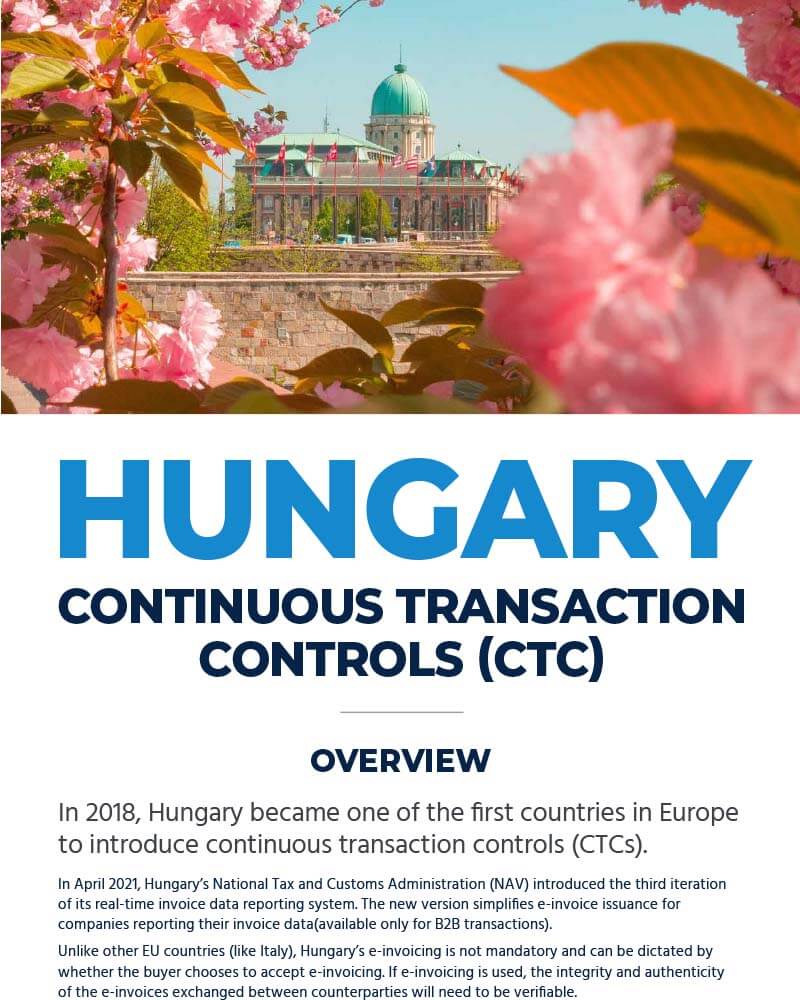
In 2018, Hungary established a legal framework requiring taxpayers to use a designed schema to report invoice data to the tax authority (NAV) in real-time for domestic transactions above a minimum VAT amount.
Due to the success of this measure, the scope of the mandate has been extended to include a wider range of transactions, and the earlier thresholds have been abolished. The impact of the mandate is now broadly felt in Hungary where all transactions between domestic taxable persons must be reported to the NAV, regardless of the amount of VAT accounted.
Have questions? Get in touch with a Sovos expert on RTIR Hungary.
Hungary VAT mandate quick facts
Immediate disclosure of data from all invoices issued under the scope of the mandate.
Once an e-invoice is issued, transmission of data must occur automatically using a machine-to-machine interface and must be done without human intervention
The transmission must include identification data and the obligatory data content as required under the Hungarian VAT Act.
VAT returns are filed monthly or quarterly and are due on the twentieth of the month after the end of the tax period.
The VAT return contains several appendices requiring additional information on transactions such as supplies of new means of transport and metals subject to the domestic reverse charge.
Alongside the VAT return, taxpayers must submit a summary report on all domestic purchases for which they’re claiming an input tax deduction.
Mandate rollout dates
1 July 2018: Mandate applies to all taxable persons to report invoice data in real-time to the National Custom and Tax administration of Hungary for domestic transactions with a minimum VAT amount of 100,000 HUF.
1 July 2020: The VAT threshold was abolished and all domestic transactions between taxable persons in Hungary must be reported regardless of the VAT accounted.
1 January 2021: Reporting obligations include B2C invoice issue and B2B intra-community supplies and exports.
1 January- 31 March 2021: The Ministry of Finance granted a sanction-free three-month grace period to comply with new reporting obligations and to give businesses time to transfer from the current version (v 2.0 XSD) to the new version v3.0 XSD.
1 April 2021: Mandatory usage of the new version (v3.0 XSD) begins.
RTIR Penalties
Failure to report the invoices in real-time could lead to an administrative penalty of up to 500,000 HUF per invoice not reported.
Additional penalties would apply for non-compliance with the invoicing software requirements.
Infographic
Hungary’s CTC Requirements
Understand more about Hungary’s NAV system, how to file invoices, when businesses are required to comply and how Sovos can help.
Sovos helps companies stay compliant with Hungary Real Time Reporting Requirements
As Hungary edges ever closer to CTC e-invoicing invoice clearance, Sovos enables businesses to stay up to date with the latest requirements and technical specifications so they can effectively connect with the NAV and honour their VAT compliance obligations.
While many governments and tax authorities are now on an e-Transformation journey, this trend began in Latin America in the early 2000s. Turkey followed suit a decade later when it began the digitization of its tax system.
Turkey is further along in its e-Transformation journey than most countries – including EU Member States, which are working towards digitization in their own way with the overarching VAT in the Digital Age initiative.
From e-invoicing to electronic self-employment receipts, Turkey now has a fully-fledged, established digital tax system with many moving parts. To understand Turkey’s e-Transformation, bookmark this page then read on.
CTC Type E-invoice clearance with both parties registered on the portal
Network Centralised – e-Fatura Portal delivers the e-invoices to Buyers for B2B transactions
Format UBL-TR format
eSignature Requirement Required – fiscal stamp or qualified electronic signature
Archiving requirement 10 years
E-arşiv Fatura Turkey
CTC Type E-invoice reporting (daily basis)
Network Decentralised – e-Fatura Portal does not deliver e-arşiv invoices; it’s the taxpayers’ responsibility
Format UBL-TR format or in a free format such as PDF and must also be available in paper form
eSignature Requirement Required – fiscal stamp or qualified electronic signature
E-Transformation in Turkey
Turkey stepped up its tax system through digitization in 2012 to help important information be gathered and transmitted with ease and accuracy. It’s further ahead than many other countries, with a variety of electronic systems and documents mandated for many taxpayers – all starting with its e-Ledger obligation.
Turkey joined the eEurope+ initiative and moved fast to ensure it was keeping up with tax digitization efforts, relieving its entire economic ecosystem where information is concerned. The aims of such changes are to reduce VAT fraud, increase governmental access to and control of data, standardise financial and accounting processes and reduce errors.
Now effectively utilising electronic versions of invoices, ledgers, delivery notes, self-employed receipts and more, there are a lot of challenges for taxpayers to overcome to remain compliant amidst Turkey’s e-Transformation.
Turkey’s ambition to electronically transform its tax ecosystem required the development and implementation of many products and services. This presented taxpayers with new requirements and, subsequently, new challenges.
Here are the products and services in Turkey’s e-Transformation system:
e-Fatura
e-Fatura is Turkey’s e-invoicing initiative. Mandated for companies with turnovers of over TRY 5 million, this obligation came into effect on 1 April 2014. There are also sector-based parameters for the nation’s e-invoicing mandate, ignoring the turnover threshold, qualifying the following for an electronic invoice obligation:
Companies licensed by the Turkish Energy Market Regulatory Authority
Middlemen or merchants trading fruits or vegetables
Online service providers facilitating online trade
Importers and dealers
Turkey’s e-invoicing initiative is a clearance model and two-way application, with issued invoices needing to be in the UBL-TR format and archived for 10 years. Sovos’ e-invoice solution enables compliance with e-Fatura requirements.
e-Arşiv Fatura
e-Arşiv Fatura is Turkey’s e-arşiv invoice initiative. Taxpayers registered in the e-Fatura system must also issue e-Arşiv invoices, either in the UBL-TR format or in a free format such as PDF.
Real-time clearance is not conducted for the issuance of these invoices, though an e-Arşiv report must be submitted electronically to the tax authority by the end of the following day. e-Arşiv invoices are always created electronically but must be available in paper form unless the buyer agrees to receive the document electronically.
e-İrsaliye is Turkey’s e-WayBill initiative. The use of e-İrsaliye documents became obligatory for taxpayers that surpass the TRY 10 million revenue threshold on 1 July 2023, though those outside of the scope can voluntarily switch to electronic WayBill documents.
There are two types of paper waybills, namely shipment and transportation. e-İrsaliye largely replaces the shipment waybill.
Information required in this type of e-document includes:
Supplier information
Issue date and document number
Buyer information
Type and quantity of the transported goods
Shipment date and time
Legally, there is no difference between paper waybills and eWayBills, though the electronic version requires both parties to be registered in the national system.
e-Defter
e-Defter is Turkey’s e-Ledger initiative. The Turkish tax authorities made the e-Ledger application mandatory for e-invoice users and taxpayers, subject to independent audit, in 2015.
These e-documents must be prepared in XBRL-GL format and include specific information in standard XML format – all signed with a financial seal. In addition to producing e-ledgers, taxpayers are required to create a ledger summary which is to be sent monthly to the TRA and archived for 10 years.
Electronic ledgers reduce the time it takes to collect data, save costs associated with the notarization process and ensure compliance with tax processes.
e-Mutabakat
e-Mutabakat is Turkey’s e-Reconciliation initiative. Reconciliation is the communication between accounts to mutually agree on the debit and credit between companies that are part of an agreement.
Turkey’s tax authority has ruled that companies are obliged to make reconciliations at particular times. The last day of the year is typically the day when the account between two parties will be closed unless an agreement or legal requirement states otherwise.
The BA-BS web application developed by the TRA for e-Reconciliation enables taxpayers to compare current agreements and unbalanced agreements before electronic submission of the BA-BA forms.
e-Müstahsil Makbuzu
e-Müstahsil Makbuzu is Turkey’s e-Producer Receipt initiative. This commercial e-document is issued by farmers or wholesalers to keep a record of the products they buy from farmers that don’t bookkeep.
Taxpayers that are obliged to issue producer receipts have had to issue electronic versions of the document, known as e-Müstahsil Makbuzu, since 1 July 2020. However, fruit and vegetable brokers or merchants have been required to issue e-Producer Receipts since 1 January 2020.
Those obliged to utilise e-Producer Receipts may be outside of the scope of e-Fatura, e-Arşiv Fatura and e-Defter requirements.
e-Serbest Meslek
e-Serbest Meslek is Turkey’s e-Self-Employed Receipt (e-SMM) initiative. This obligation came into effect on 1 February 2020 and applies to all self-employed individuals, including:
Architects
Engineers
Financial advisors
Lawyers
Screenwriters, writers, composers and painters
Self-employed doctors, dentists and veterinarians
e-SMM receipts can be created, submitted and reported electronically and carry the same legal weight as paper Self-Employment Receipts. They must be archived for 10 years.
While all the above are prominent e-documents, there are even more electronic documents in Turkey that you should know about. To learn more, read our e-documents overview.
Who is affected by e-Transformation?
E-Transformation includes many documents, each subject to specific thresholds and criteria based on their type. Additionally, certain documents are mandatory for particular sectors without any threshold criteria. E-invoicing is now mandatory for the majority of taxpayers, but it is important to understand which documents are required to be submitted to the tax authorities.
The TRA continues to announce new taxpayer groups in scope of the different document types, so it’s important that businesses stay up to date with the latest information to ensure they remain compliant.
What are the benefits of e-Transformation?
Turkey’s tax transformation aimed to deliver benefits to both the government and taxpayers.
The e-Transformation initiative aims to produce the following benefits:
Real-time collection of financial data
Reduce VAT fraud and the circulation of fake invoices
Increased standardisation to automate accounting processes
Improved efficiency and reduction of manual errors through data auto-population
Tax compliance and e-Transformation
Turkey’s e-Transformation has impacted tax compliance, successfully implementing real-time transmission of important financial data.
With data automatically being populated in documents, it reduces the possibility of error via manual input and fraudulent invoices being submitted. The reduction of the VAT gap has been a driving force for many countries, including Turkey.
Eliminating paper, cartridge, shipping and archiving costs associated with paper invoices is also an advantage to businesses and government.
With over 16 document regulations, Turkey’s e-transformation system requirements are extensive and complex. Understanding which regulations apply and keeping up with the latest tax compliance guidelines is key.
How Sovos can help with your e-Transformation journey
Sovos provided the first global e-Transformation solution suite, helping businesses of all shapes and sizes to meet the demands of Turkish tax mandates. Our platform meets all the requirements, standards and formats defined by the Turkish Revenue Authority.
Organisations choose Sovos as their global compliance partner, partly due to the convenience of having a single vendor to aid compliance wherever and however they do business.
A special integrator is an intermediary service provider authorised by the Turkish Revenue Administration. Special integrators have the authority to create electronic records on behalf of taxpayers.
Sovos recently sponsored a benchmark report with SAP Insider to better understand how SAP customers are adapting their strategies and technology investments to evolve their finance and accounting organizations. This blog hits on some of the key points covered in the report and offers some direct responses made by survey respondents, as well as conclusions made by the report author. To get the full report, please download your complimentary copy of SAP S/4HANA Finance and Central Finance: State of the Market.
In this year’s benchmark report, research found that most companies are focused on reducing complexity and cost as a primary driver of their overall finance and accounting, including tax, strategies. With this reduction, they are working to solve their biggest pain point which continues to be a lack of visibility into financial transactions and reporting.
The survey revealed several key strategies and investments that SAPinsiders are prioritizing to evolve their finance and accounting processes and organizations. The number one driver of finance and accounting strategy in 2021 is to reduce cost and complexity. This was named by 57% of our audience as the top driver of their finance and accounting strategy. This jumped 24% from last year. To support their top drivers, a majority (56%) of the finance and accounting teams in the study plan to increase their use of automation in 2021.
Clean and harmonized data and a centralized single point of truth are the most important requirements that SAPinsiders are prioritizing. 83% of survey respondents report that clean data is important or very important, while 80% highlight the significance of the Universal Journal in centralizing critical information.
How do technology and tax intersect?
Continued complexity within core financial and accounting systems is limiting organizations’ ability to adapt rapidly to changing business conditions and provide real-time visibility into operations. That is why the number one driver of finance and accounting strategy based on this year’s survey is the pressure to cut both cost and complexity.
Survey responses and interviews with customers about their largest sources of pain consistently mention system and process complexity as one of their most significant challenges. Respondents are focused on addressing this obstacle in a variety of ways such as through investments in analytics, automation, centralization, and system consolidation.
This directly impacts how companies approach tax as rapidly changing global tax laws and mandates often have organizations playing catch up to ensure they are charging and remitting the proper amounts of tax to each country in which they operate. Failure to do this can lead to costly audits, potential fines and penalties and damage to brand reputation.
Why move to SAP S/4HANA Finance?
Simplicity, speed, and easy access to data were among the top benefits cited by survey respondents who have completed or nearly completed their move to SAP S/4HANA Finance. Several mentioned the ease with which they can go from high-level reports and drill down to the document or line-item level, making it easier to understand the numbers and perform in-depth analysis quickly. This directly aligns with the pain points that were identified in the benchmark report survey.
Why now?
What is clear from this survey and subsequent report is that complexity across all layers of finance is having a direct impact on a companies’ ability to function at the highest operational level possible and is threating to impact the bottom line.
Accounting for tax early in your migration strategies and technology upgrades is a key component to ensuring that you are prepared to handle the challenges of modern tax on an international scale. For companies that operate on a multi-national basis, having a centralized approach to tax with enhanced visibility and reporting capabilities is imperative to achieving and remaining compliant no matter how many changes to tax law are introduced every year.
Please download the full report for a more detailed explanation of these critical areas of focus.
Six months after Brexit there’s still plenty of confusion. Our VAT Managed Services and Consultancy teams continue to get lots of questions. So here are answers to some of the more common VAT compliance concerns post-Brexit.
How does postponed VAT accounting work?
Since Brexit, the UK has changed the way import VAT is accounted for. Before January 2021, you had to pay or defer import VAT at the time the goods entered the UK. Because of the volumes of trade between the UK and the EU, the government have understandably changed this. So, now rather than having to pay import VAT you can choose to postpone it to the VAT return. In practice, this effectively means it’s paid and recovered on the same VAT return. This is a significant cash flow benefit. It’s common among many EU Member States and it was allowed in the UK many years ago. The UK reintroduced it from the start of this year.
There’s no need to be approved to use postponed VAT accounting but an election to use it must be made when completing each customs declaration. It doesn’t happen automatically and the reality is that businesses can choose whether they want to use it or not. The import VAT is then accounted for in box 1 of the UK VAT return and then recovered in box 4. If you’re a fully taxable business and the VAT is recoverable, this will mean that there is no need to make any payment of the import VAT. There are no costs involved in using postponed VAT accounting. The business will have to download a monthly statement from the Customs Declaration Service. The statement shows the postponed amount of VAT.
There are also import VAT accounting mechanisms in place in the EU but they vary from country to country. If you’re a UK business and you’re going to be the importer of the goods into the EU, there is the ability to use postponed accounting in some other countries but the rules on how it applies can vary. In some countries it’s like the UK, so no permission required.
In others you’ll need to make an application and meet the conditions in place. If there is no postponed VAT accounting, there may be the opportunity to defer import VAT which can still provide a cash flow benefit. It’s really important that companies understand how it works in the Member State of import, and if it’s available to them as it can have a big impact on cash flow. It’s good news that the UK have reintroduced postponed VAT accounting as it’s certainly a benefit and applies to all imports, not just those that come from the EU.
I’m shipping my own goods to a third party logistics provider in the Netherlands. I will ship the goods to customers around the EU. How do I value the goods for customs purposes as they remain in my ownership? They’re not of UK origin so customs duty may apply.
This question comes up a lot as customs valuation, like the principle of origin has not arisen for many years for UK companies who have only traded with the EU.
The rules on customs valuation are complex. In this scenario, there is no sale of the goods. So it’s not possible to use the transaction value which is the default valuation method. As customs duty is not recoverable, it’s essential that the correct valuation method is used. This minimises the amount of duty paid and also to remove the possibility of the customs and VAT authorities challenging a valuation. We would recommend seeking specialist advice.
If I sell B2C to customers in the EU do I need to register for VAT in each Member State?
When goods go from Great Britain to the EU, we’re currently in the transition period between Brexit and the introduction of the EU e-commerce VAT package which comes into play on 1 July 2021. Until then, whether you need to be registered or not in an EU country depends on the arrangements in place with your customer. If you sell on a Delivery Duty Paid (DDP) basis, you’re undertaking to import those goods into the EU. So if you do that, you’ll incur import VAT on entry into each country and then make a local sale. If you do that in every Member State country, you’ll have to register for VAT in every Member State.
It should be noted that these are the rules for GB to EU sales and not those from Northern Ireland. This is because the Northern Ireland protocol treats NI to EU sales under the EU rules. The distance selling rules that were in force before the end of 2020 still apply.
Going forward, the EU has recognised that this isn’t really a manageable system. There has been significant abuse of low value consignment relief. LCVR relieves imports of up to €22 from VAT. So they’re introducing a new concept – the Import One Stop Shop (IOSS). IOSS will be available from 1 July 2021 as part of the EU E-Commerce VAT package. From this point, the principle is that for goods with an intrinsic value of below €15. you can use the IOSS. IOSS accounts for VAT in all the countries to which you deliver. You only need a VAT registration in one country where you then pay all your VAT. You submit one return in that country on a monthly basis. This should simplify VAT compliance and ease the admin burden.
There will also be a One Stop Shop (OSS) for intra-EU transactions. So the simplifications ahead will reduce the burden to businesses. What’s important is making sure you review your options. Make an informed decision as to which is the right scheme for your business. Ensure you can comply with VAT obligations to avoid VAT compliance problems in the future.
In Poland, the Ministry of Finance proposed several changes to the country’s mandatory JPK_V7M/V7K reports. These will take effect on 1 July 2021. The amendments offer administrative relief to taxpayers in some areas but create potential new hurdles elsewhere.
Poland JPK_V7M and V7K Reports
The JPK_V7M/V7K reports – Poland’s attempt to merge the summary reporting of a VAT Return with the detailed information of a SAF-T – have been in effect since October 2020. Taxpayers must submit these reports (V7M for monthly filers, V7K for quarterly filers) in place of the previously-used VAT Return and JPK_VAT files.
The JPK_V7M/V7K reports require taxpayers to designate within each file the invoices subject to special VAT treatment. For example, invoices representing transfers between related parties or invoices for transactions subject to Poland’s split payment regime.
Split payment designations are particularly complex for taxpayers to manage. Poland’s split payment regime is broadly applicable. In some cases can be exercised at the buyer’s option. This makes it difficult for sellers to predict which of their invoices should be marked.
As a result of these complexities, and in response to taxpayer feedback, the draft amendment for 1 July would abolish the split payment designation. This would significantly reduce the administrative burden on taxpayers.
The draft amendment does, however, give rise to an additional complexity in the reporting of bad debts. Under the amended rules, taxpayers need to indicate the original due date of the payment for an unpaid invoice. For which the taxpayer is seeking a VAT relief. This is intended to help the tax authority verify bad debt relief claims. This could potentially present difficulty for taxpayers who do not maintain such information or cannot easily access it in their accounting systems.
Poland and EU One Stop Shop
Finally, the draft amendment would modify reporting of cross-border business to consumer (B2C) supplies of goods. This is as well as similar supplies of electronic services. These supplies are at the heart of the European Union’s One-Stop Shop regime that takes effect 1 July 2021, and as such, the current invoice designations for these supplies in JPK_V7M/V7K would be consolidated into a single, new invoice designation under the amended rules.
Poland’s JPK_V7M/V7K filings are enormously ambitious in scope. It is clear from these latest proposals that the tax authority is willing to make substantial adjustments to the structure of these filings, at very short notice. In such a dynamic landscape, it is critical that businesses stay on top of regulatory developments in order to remain compliant.